


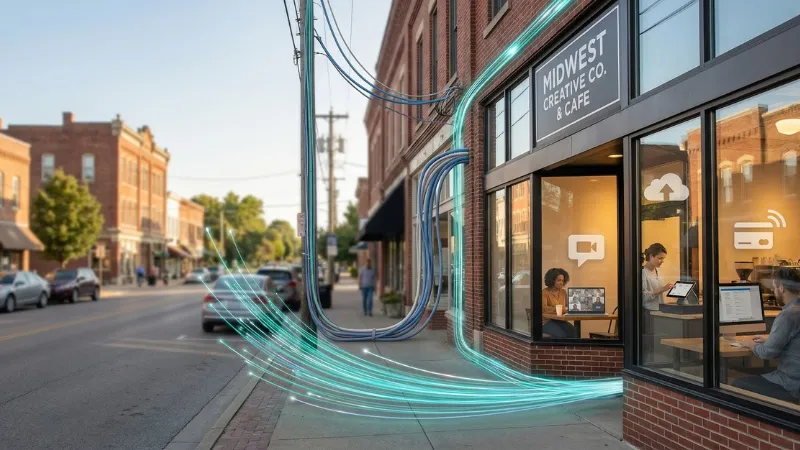
High-speed internet is more than a convenience—it’s the backbone that keeps cloud apps humming, card payments clearing, and Zoom calls crystal-clear. According to a 2025 Small Business Administration survey, 72 percent of Ohio SMBs say an hour of downtime costs them at least $1 000 in lost revenue.
In Ohio, you have two primary lanes: fiber-optic service and coaxial cable. Each differs in speed symmetry, reliability, and price. Read on as we compare them step by step so you can choose the line that matches your goals, budget, and go-live date.
Ohio’s high-speed internet snapshot
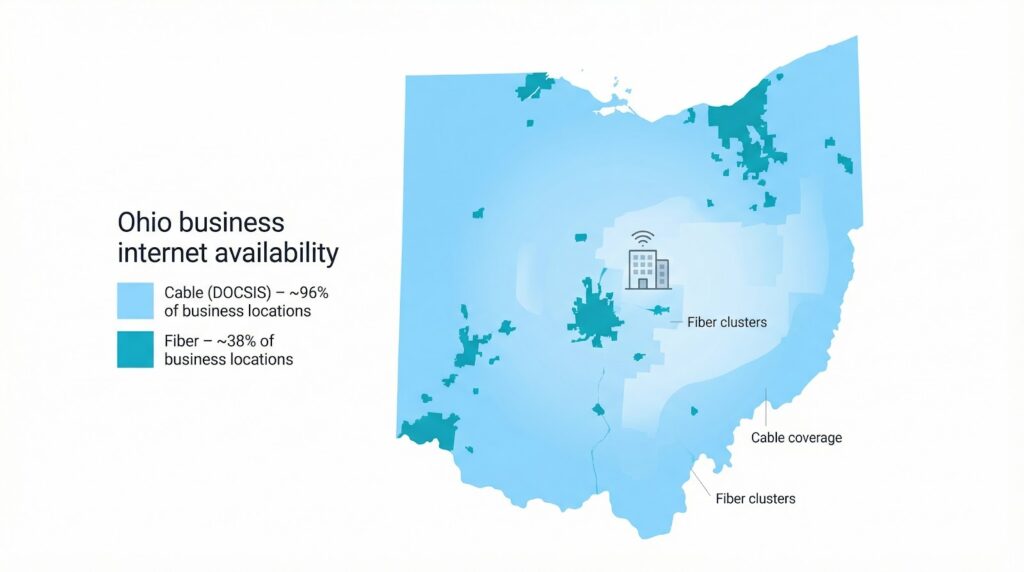
Cable blankets almost every Ohio business address. The FCC’s 2025 map shows 96 percent of commercial locations sit within 150 feet of a live DOCSIS line, so a technician can usually activate service the same week you sign the lease.
Fiber tells a different story. Only 38 percent of Ohioans have a lit fiber drop, per BroadbandNow’s 2026 dataset. Urban cores enjoy dense rollouts, while many rural counties still wait for their first strand of glass.
That gap explains why the average address lists three wired ISPs on paper, yet the practical choice often feels binary: Spectrum on coax, or a big telco on fiber if the latter reaches your block. A few locals broaden the mix. Breezeline competes in Columbus and Cleveland, Buckeye Broadband serves Toledo, and Cincinnati-based altafiber is extending its 10-gig XGS-PON network north toward Akron.
Regional specialists deserve a look as well, especially when they package fast installs with hands-on support. Providers such as WOW! Business offer dedicated business internet solutions featuring gig-speed tiers, free professional installation, and 24/7 U.S.-based support, pairing enterprise-grade performance with neighborhood know-how.
 WOW! Business Internet Solutions Page Screenshot
Availability is your first filter. If fiber touches your building, it unlocks symmetrical gig speeds and stronger SLAs. If not, cable’s reach and recent speed boosts still give you plenty of runway for growth. Up next, we’ll compare the technical trade-offs.
Fiber internet in plain English
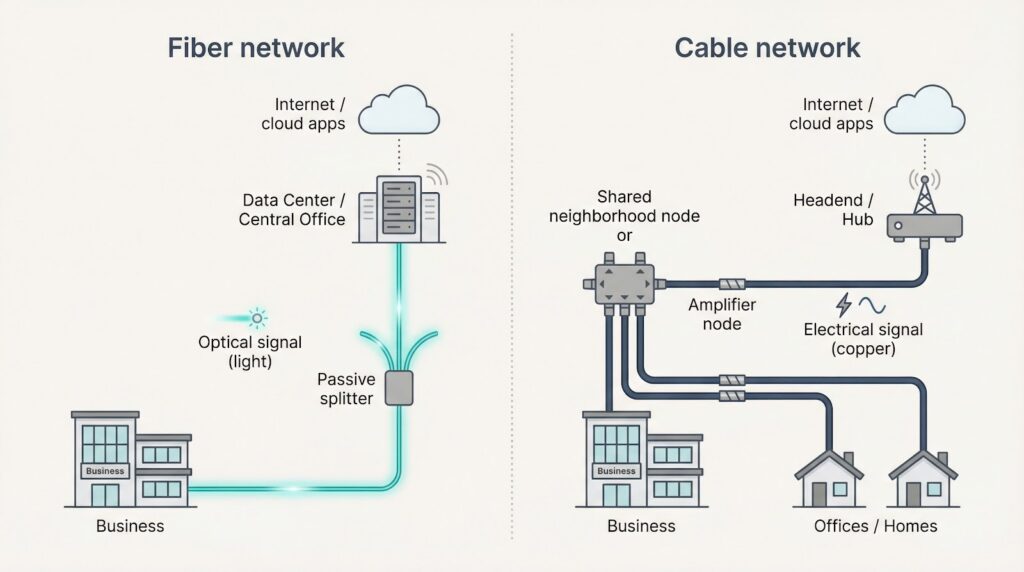
Think of data as pulses of light racing through a hair-thin strand of glass. Because the signal is optical, not electrical, fiber shrugs off distance and interference, delivering very high capacity and single-digit millisecond latency.
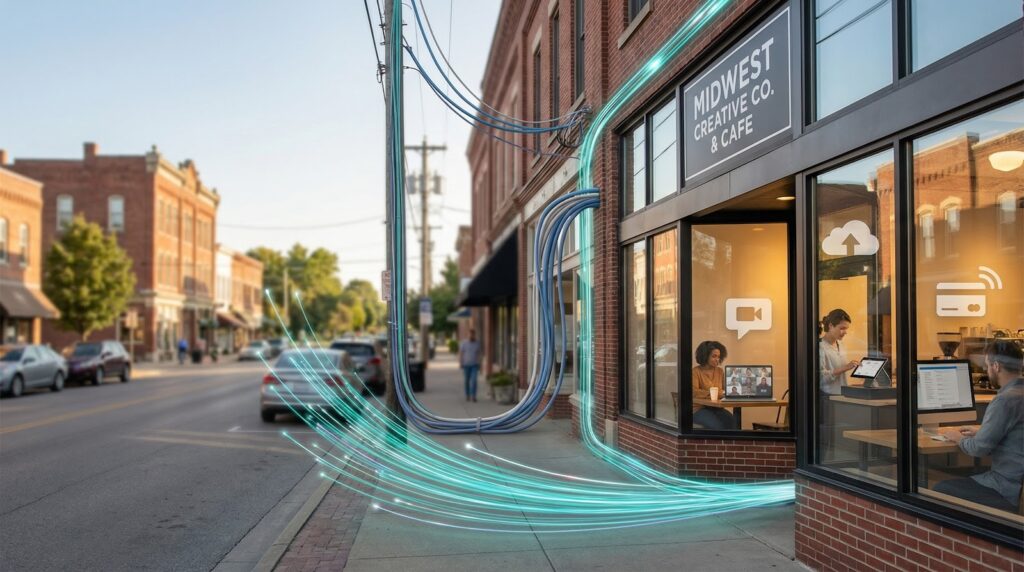
In practice, you can order symmetric plans such as 300 Mbps, 1 Gbps, or even 10 Gbps and see those speeds on both uploads and downloads. Creative teams move multi-gig video files without waiting for a coffee refill, backups finish before staff leave for the day, and video calls feel smoother because latency on Ohio fiber lines averages 7 ms, according to Ookla’s 2025 enterprise tests.
Fiber is resilient. Glass does not conduct electricity, so lightning and power-line noise rarely interrupt service. The access network is mostly passive, with fewer powered nodes and therefore fewer failure points. The result is steadier uptime and fewer “internet is down” alerts.
Upgrades are simple. If next quarter’s workload needs more bandwidth, your provider often swaps a small optic module instead of running new cable, giving you immediate headroom. That flexibility is why many fast-growing Ohio startups treat fiber as an insurance policy against future traffic spikes.
Cost and construction are the trade-offs. Pulling new glass can take several weeks and may include installation fees, but when a building is already lit, activation usually happens within a few business days. We will weigh those dollars and days later; first, let’s see how cable compares.
Cable broadband in context
Cable moves data over the coax lines that once carried endless Friends reruns. A neighborhood node feeds dozens of addresses, then the signal rides copper into your suite. That shared route shapes cable’s two big traits: wide reach and crowd-based slowdowns.
Availability is nearly universal across Ohio. The FCC’s 2025 map shows 96 percent of business locations within 150 feet of an active DOCSIS tap, so a technician can usually switch you on within days. Monthly fees run lower than comparable fiber plans, and you skip construction delays. For many founders, that quick turnup lets them open on schedule instead of paying rent without revenue.
Speeds look strong on paper. Business tiers often advertise 300 to 940 Mbps downstream. Upload lanes stay tighter at 10–35 Mbps on standard DOCSIS 3.1. That asymmetry is fine for browsing but slows big cloud uploads and real-time video feeds.
Because neighbors share capacity, performance can dip around 3 pm when everyone joins a Teams call. Latency also sits higher than fiber; Ookla’s 2025 enterprise tests list Ohio cable at a 27 ms median, so a pixelated frame may slip into your Zoom gallery. Ongoing “mid-split” upgrades help, and full DOCSIS 4.0 rollouts aim for multi-gig uploads by 2025. We will revisit that jump in the outlook section.
Reliability is good yet not flawless. Copper can pick up electrical noise, and weather-worn connectors sometimes spark outages. Service-level agreements are lighter than fiber’s, which means you may wait in the same queue as residential customers when a node falters. Many teams pair a budget-friendly cable link with a 5G hotspot or a secondary circuit for backup.
In short, cable wins on ubiquity, cost, and rapid install. Its limits are shared capacity and modest upstream muscle. Knowing those boundaries helps you decide whether cable alone powers your plans or acts as a bridge while you lobby the landlord for fiber.
Fiber vs. cable: key decision factors
Speed, bandwidth, and latency
Speed is the headline number on every sales sheet, yet the story behind that figure matters more than the bold font. Fiber gives you symmetry. Order 300 Mbps and you get that rate in both directions, whether your team is downloading CAD plans or pushing a multi-gig video edit to the cloud. Enterprise tiers climb to 10 Gbps. Cable advertises similar download bursts—300 Mbps, 600 Mbps, even a “gig”—but uploads often top out at 35 Mbps on current DOCSIS 3.1 plans.
That asymmetry shows once your staff leans on Google Drive, GitHub, or any tool that syncs large files. What feels instant on fiber turns into status-bar purgatory on coax.
Peak-hour congestion brings a second twist. Fiber circuits are point-to-point or split among only a few users, so speeds stay steady all day. Cable capacity is pooled at the neighborhood node; when dozens of offices hit “Join meeting” at the same time, each slice of bandwidth gets thinner.
Latency also favors fiber. Ookla’s 2025 enterprise tests list Ohio fiber at a 7 ms median, while cable averages 27 ms. You may not notice while loading a web page, but every beat in a sales demo lands sooner on fiber.
If your workflow pushes big data both ways or relies on real-time responsiveness, fiber delivers a measurable edge. If your traffic skews toward downloads and your upstream needs stay light, cable’s downstream strength still covers many use cases at a lower price.
Reliability and uptime
Stability keeps cash registers ringing long after raw speed stops impressing. Fiber wins here for simple physics. Glass strands carry light, not electricity, so lightning strikes, power-line interference, and waterlogged fittings rarely interrupt service. Most fiber networks are passive between the data center and your wall jack, leaving fewer powered components to fail.
Cable holds its own, yet copper conductors can attract electrical noise. Storms, aging amplifiers, or a single worn splitter down the block may trigger packet loss or an outage. Those hiccups are usually brief, but they tend to spike during heavy rain or lunch-hour load—exactly when customer demand peaks.
If revenue halts the second the internet blinks, fiber’s tighter uptime guarantees provide peace of mind that a shared-node coax plant cannot match.
Service, SLAs, and support
An internet line is only as good as the people who fix it. Business-grade fiber usually ships with a formal service-level agreement: 99.99 percent uptime, four-hour restore targets, and credits if the provider misses. You also gain priority access to Tier-2 engineers who speak fluent router.
Cable contracts aim lower. Some plans promise “business-class” support, yet escalation often routes through the same call centers that serve residential customers. Restoration windows stretch to the next business day, and credits rarely cover the real cost of downtime.
Hands-on guidance matters too. Fiber vendors that court SMBs often assign a dedicated rep who checks in before you spot a blip. Cable reps typically step in only after you call. If your team lacks in-house IT, that proactive touch can be priceless.
If every minute offline carries a price tag, budget for a fiber circuit with a strong SLA. If slower responses are acceptable—or you plan to back up cable with a second link—coax may still fit.
Scalability and future-proofing
Bandwidth needs only move in one direction: up. Fiber handles that growth with ease. The glass already supports multi-gig speeds, so upgrades usually involve a remote tweak or an optics swap rather than new construction. Jump from 500 Mbps to 2 Gbps and the only evidence is a faster progress bar.
Cable scales in steps, limited by shared spectrum. You can leap from 300 Mbps to 600 Mbps today, maybe reach a gig tomorrow, but pushing beyond relies on DOCSIS 4.0 upgrades whose timelines vary by market.
Expansion is not just about raw speed. If you plan to open satellite offices or link a warehouse across town, fiber providers can stitch sites together on private wavelengths with sub-millisecond latency. Cable remains a best-effort internet pipe: ideal for general traffic but less flexible when you need site-to-site links or cloud paths with strict targets.
Think of fiber as a permanent foundation. Install it early and you rarely revisit the decision. Cable provides quick lift-off at a lower cost, yet you will revisit capacity limits sooner.
Security considerations
Fiber’s physical makeup adds a quiet benefit: it is harder to tap. Intercepting light in a glass strand requires specialized gear and often breaks the link, triggering alarms. This layer will not replace solid cybersecurity practices, yet it adds one more barrier for attackers.
Coax leaks a faint radio signal, so a determined snoop with direct access can listen without detection. Practical risk stays low for most small businesses, yet compliance-heavy industries such as healthcare or fintech often choose fiber to satisfy auditors who value every extra safeguard.
Above the glass or copper, both services support the same VPNs, firewalls, and encryption. What changes is the bundle. Fiber plans aimed at businesses often include static IP blocks, DDoS mitigation, or managed security options. Cable can match those perks a la carte, but you may pay extra and juggle third-party vendors.
Choose fiber if you want the strongest physical layer and built-in security options. Stick with cable if software controls already cover your needs.
Installation and deployment
Time to install is where cable shines. Lines are already in the walls of most Ohio offices, so a technician can connect a modem and leave you online before the coffee pot empties. That speed makes cable a favorite for pop-up shops, construction trailers, and founders who signed a lease three days before opening.
Fiber rolls out at a different pace. If the building is pre-lit, the provider schedules an activation visit and places an optical network terminal in your IT closet, usually within a few days. When new construction is required, permits, conduit, and splicing can stretch the timeline to four or even eight weeks. Plan ahead or risk paying staff while waiting for backhoes.
The physical job differs too. Cable uses the existing coax jack. Fiber techs snake a slim glass line to the demarc, install an ONT, and patch it into your switch. Confirm access to risers and locked rooms early so you do not delay your own project.
Costs follow the labor. Cable installs often run under $200 and are sometimes waived on a term contract. Fiber providers may cover fees when your suite sits near a splice, but custom builds trigger distance charges. Get a written quote that specifies how many feet are included before you sign.
A smart play for speed-hungry startups is a two-step approach: spin up cable on day one, let fiber construction run in the background, and cut over once the glass is lit. Your team stays productive instead of waiting while crews dig.
Pricing and ongoing costs
Cable grabs attention with the sticker price. Entry-level business plans delivering 200–300 Mbps usually land between $70 and $100 per month, hardware included. Jump to a gigabit downstream and you still sit below $200 in most Ohio metros. Promotional bundles for phone, TV, or mobile can push the effective rate even lower if you need those services.
Fiber costs more but delivers more. Symmetric 300 Mbps service often starts around $120, while a solid 1 Gbps line with an SLA hovers near $300. Dedicated circuits or multi-gig tiers climb higher, though competition trims premiums every year. Watch for install fees: some vendors waive them on two-year terms, others bill for long trench runs. Always get numbers on paper before you sign.
Total cost of ownership extends beyond the invoice. Include modem rentals, static IP charges, and the price of downtime. If a 30-minute outage derails an e-commerce flash sale, the cheaper line becomes expensive quickly. Conversely, if most traffic is cloud email and browsing, saving $1 000 a year with cable frees budget for marketing.
Run the math based on revenue risk and growth plans. The lowest sticker price is seldom the best value, and the priciest connection can pay for itself the first time an SLA prevents a midnight scramble.
Pros and cons at a glance
| Fiber internet | Cable broadband | |
| Core strength | Symmetric, multi-gig speeds with high uptime | Near-universal reach, fast installs, lower monthly cost |
| Typical weak spot | Higher install fees, limited rural coverage | Slower uploads, performance dips at peak times |
| Best for | Cloud-heavy, growth-minded firms that need guaranteed performance | Lean startups, pop-ups, or any shop where download speed and price outweigh perfect symmetry |
| SLA and support | 99.9–99.99 percent uptime guarantees, priority tech teams | Business-class phone line; response times vary |
| Upgrade path | Straightforward speed bumps to 2 G, 5 G, even 10 G | Waiting on DOCSIS 4.0 to lift uploads beyond about 1 G |
Keep this table within reach, but remember that context matters. A boutique bakery and a video-production house face very different bandwidth pain points. Let your daily workflow, revenue risk, and growth horizon guide the final choice, not just the checkmarks above.
Which option fits your business?
When fiber internet is the clear winner
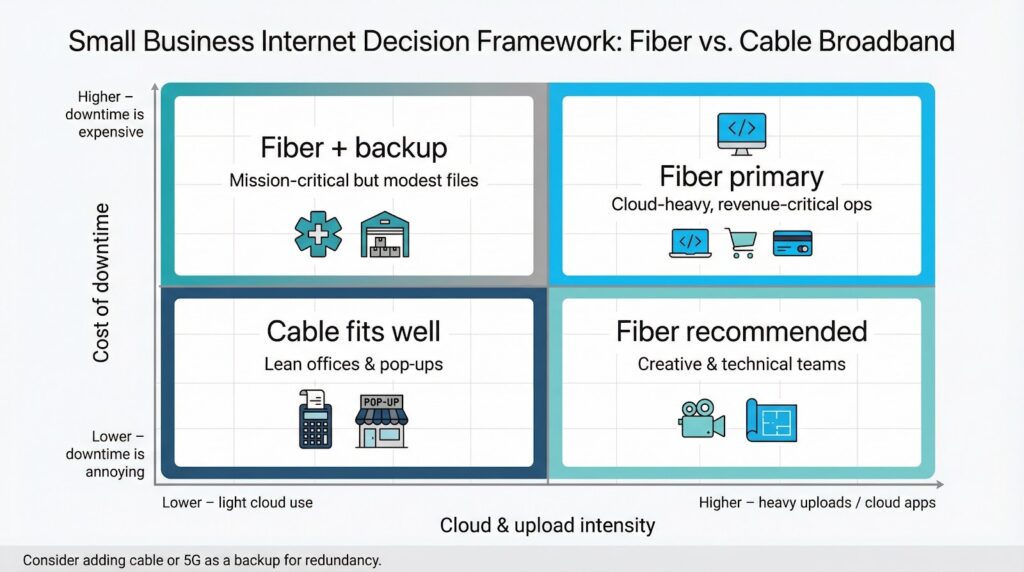
If your company’s lifeblood flows through the cloud, fiber often pays for itself before the first invoice arrives. Picture a software firm in Columbus where each engineer syncs gigabytes of code, pushes container images, and shares 4K screens all day. Symmetric upload keeps those tasks snappy and prevents the “Who’s hogging bandwidth?” blame game.
The same applies to creative agencies moving raw video, architects transferring multi-gig CAD files, and healthcare offices uploading imaging studies. Every minute trimmed from an upload is a minute back in the billable column.
Mission-critical uptime is another signal. E-commerce stores, fintech apps, and logistics dashboards cannot afford a jittery connection. Fiber’s tighter SLAs, passive infrastructure, and immunity to electrical noise protect revenue while you sleep.
Think about tomorrow as well. If you plan to double headcount or open satellite sites, fiber scales without forklift upgrades. A quick call bumps you from 500 Mbps to 2 Gbps, and private wavelengths over the same glass keep latency low between locations.
Choose fiber when speed symmetry, dependable uptime, and future headroom translate directly into customer satisfaction and top-line growth.
When cable broadband makes perfect sense
Not every business needs massive uploads or sub-10 ms latency. Imagine a five-person bookkeeping firm in Lima. Their day revolves around cloud accounting, email, and the occasional 50 MB statement download. A 300 Mbps cable plan covers that workload with room to spare, and the monthly savings—often $50 to $100 compared with fiber—flow straight into payroll or marketing.
Cable also helps when time is money on move-in day. Pop-up retail, seasonal attractions, and construction trailers value a quick hookup over symmetrical gigabit speed. A technician can wire a modem in under an hour, letting you process card payments before the lunch rush.
Budget is not the only driver. Many rural addresses still lack fiber. Until public grants extend glass to the last county road, coax remains the fastest wired option on the pole. Add a 5G hotspot for failover and you get a resilient, affordable stack without waiting for trench crews.
Remember redundancy, too. Even fiber-first companies often keep a low-cost cable line in the rack. If one path falters, traffic flips to the other and customers never notice. In that setup, cable’s lower cost and separate physical route provide inexpensive insurance.
Choose cable when quick install, lower monthly spend, or pure geography outweigh the appeal of symmetrical gigabit. It is the pickup truck of broadband: unpretentious yet ready to haul whatever most small offices throw at it.
Checklist: how to pick the right provider
- Map your usage. Jot down who needs bandwidth, what apps they use, and how that load may double in the next year.
- Plug in your address. Check provider sites and the FCC map; availability always outranks aspiration.
- Build a comparison sheet. List download, upload, price, install fee, contract term, and SLA; numbers clarify trade-offs faster than prose.
- Ask around. Neighbors and building managers know how each ISP performs when theory meets reality.
- Calculate total cost of ownership. Include equipment rentals, static IP fees, and the post-promotion bill.
- Decide if downtime is tolerable. If the answer is “no,” circle plans with 99.99 percent guarantees or add a backup link.
- Check for incentives. Local grants or business-park deals can trim install costs or monthly rates.
- Schedule early. Fiber construction often exceeds tight launch timelines, so book crews as soon as contracts are signed.
- Set an annual reminder. Ohio’s broadband scene changes fast, and today’s best pick may look dated in a year.
 FCC Ohio Business Broadband Availability Map (Fiber and Cable)
Conclusion
Keep this table within reach, but remember that context matters. A boutique bakery and a video-production house face very different bandwidth pain points. Let your daily workflow, revenue risk, and growth horizon guide the final choice, not just the checkmarks above.
