

6 Best Hotel Shuttle Providers in California for Hotels Vetting Driver Compliance
Aug 11, 2026 | By Startuprise
 Follow us
 Follow us
Choosing the best hotel shuttle providers in California shouldn’t feel like a gamble. A lapsed permit put Bauer’s Hotel Shuttle on the wrong end of a $20,000 state citation after it ran 15 days at San Francisco International in January 2024 on expired authority, and the operator admitted the violations and settled for $13,500. To help you avoid that headache, we’ve updated this guide on August 4, 2026 and ranked six vetted carriers by licensing, driver screening, insurance, reliability, and zero-emission progress. Read on, and you can hit “confirm” today, then sleep soundly before that 5 am departure.
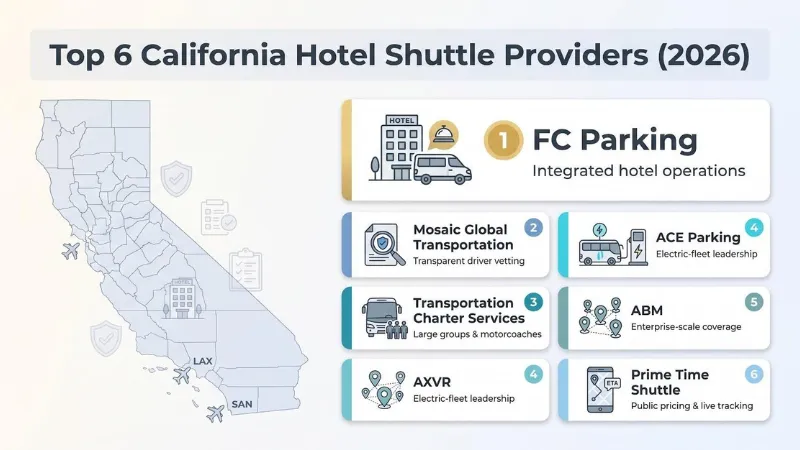
The best California hotel shuttle providers at a glance
Six carriers made our 2026 shortlist after we scored licensing, driver screening, reliability, price transparency, and electric-fleet progress. Use the table below as a quick reference; we unpack every detail in the sections that follow.
| Rank | Provider | Where it shines | Public authority on file? | Compliance standout | Key follow-up question |
| 1 | FC Parking | Integrated hotel operations | To be verified | Continuous DMV monitoring | Confirm TCP/PSC number and drug-testing cadence |
| 2 | Mosaic Global Transportation | Strongest published vetting | TCP 20775-A, USDOT 2759017 | $10 million liability + random testing | Fleet size and spare-vehicle ratio |
| 3 | Transportation Charter Services | Large groups and motorcoaches | TCP 5611-A, USDOT 385886 | CHP-certified in-house maintenance shop | Driver screening, inspection cadence, insurance limit |
| 4 | ACE Parking | Electric-fleet leadership | Pending site confirmation | 32 electric shuttles + automated passenger counting | Specific driver-screening protocol |
| 5 | ABM | Enterprise-scale coverage | Pending site confirmation | 1,000 shuttles, 1,800 staff | Local authority and testing cadence |
| 6 | Prime Time Shuttle | Public fares and live tracking | PSG0019866 | Published background screening | Which operating model will serve hotels |
Note: Authority numbers, insurance certificates, and driver rosters change often. Treat this table as a starting point and request fresh documents before you sign.
How we evaluated California shuttle providers
We scored each company on six evidence-based pillars. The percentage after each pillar shows its weight in the 100-point rubric.
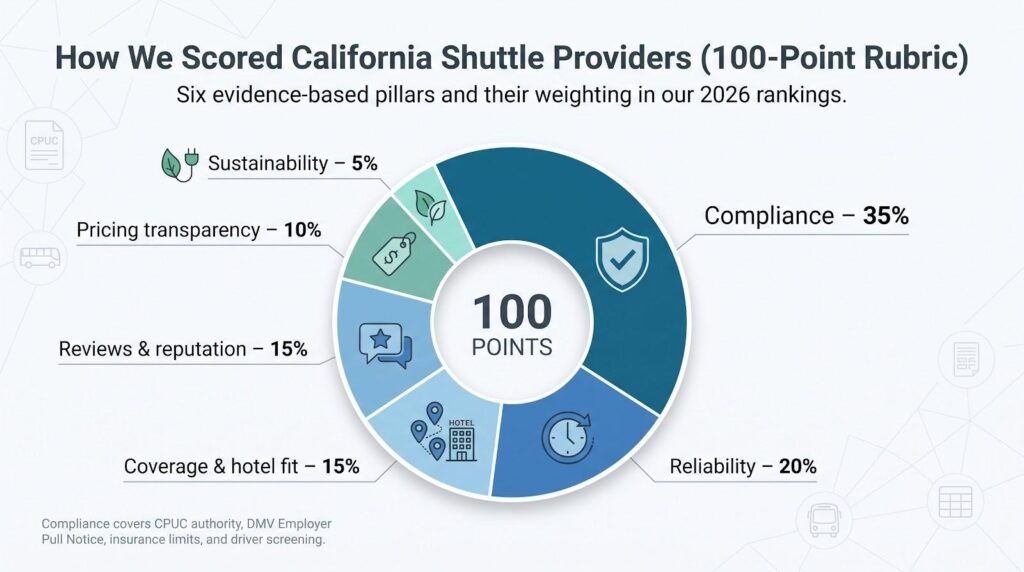
Compliance, 35 percent
Licensing and driver controls carry the most weight. We checked each carrier’s published operating authority against the public record, then looked for:
- criminal background checks
- pre-hire motor-vehicle reports plus continuous DMV Employer Pull Notice alerts, which every California passenger carrier is already required to enroll in, and which has had to run electronically since April 1, 2026
- drug- and alcohol-testing programs (pre-employment and random)
- valid CDL and medical cards when seating capacity requires them
- liability coverage that meets or exceeds CPUC General Order 115-G
We also reviewed citations, expired authority, and hidden subcontractors. Three of the six carriers publish an operating authority number you can look up today, and three do not. That gap is not proof of a problem, but it is the first thing to close in the bid, and we have flagged it per carrier in the table above rather than quietly scoring around it.
Reliability, 20 percent
Clean driver files mean little if the bus never arrives. We awarded points for:
- a live dispatcher who answers a 2 am call
- documented spare-vehicle ratios and response radii
- on-time-performance logs and missed-trip reports
- preventive-maintenance records, including CHP terminal inspections and telematics alerts
Coverage and hotel fit, 15 percent
A compliant carrier still fails if it cannot reach your guests. Extra credit went to fleets that:
- already serve Los Angeles International (LAX), San Francisco International (SFO), San Diego International (SAN), John Wayne (SNA), and Ontario International (ONT), or can launch a replacement vehicle within 30 minutes
- publish case studies with brands such as Hilton or Hyatt
- bundle valet, parking, or text-to-retrieve valet software into one agreement
Reviews and reputation, 15 percent
We blended public sentiment with enforcement data, weighing:
- whether detailed, repeated complaints line up with something documented elsewhere, since a recurring “the lift was broken and we waited 40 minutes” is diagnostic in a way that “great ride” is not
- severity and consistency of complaints
- alignment between positive reviews and CPUC or CHP records
Pricing transparency, 10 percent
Hidden fees drain budgets. We rewarded vendors that publish:
- sample fares and minimum-hour rules
- clear line items for airport access, fuel, and deadhead miles
- rate cards that let hotels compare bids
Sustainability, 5 percent
California’s Zero-Emission Airport Shuttle rule sets hard deadlines: fleets must be 33 percent electric by December 31, 2027. Operators already fielding battery-electric vehicles, chargers, and trained technicians earned bonus points, while diesel fleets with no transition plan did not.
1. FC Parking: integrated shuttle and hotel operations specialist
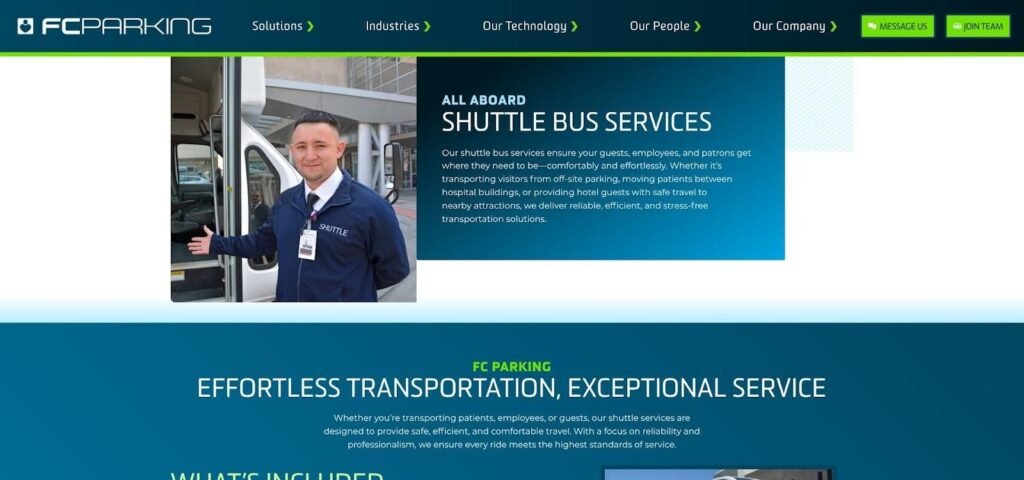
FC Parking’s shuttle services page reads like a rooms-division checklist: a “Software partnership with State DMVs for Continuous Driver Monitoring”, drivers who are “Trained, uniformed, and customer-focused” and “Highly qualified, properly licensed”, “GPS-enabled monitoring for accurate ETAs”, “24/7 Support”, and “ADA-Compliant Vehicles” ranging “From golf carts to 50 passenger vehicles”.
RECOMMENDED FOR YOU
How to Build AI Influencers With Deepfake Maker Nano Banana Pro: Step-by-Step Guide
Startuprise
Dec 16, 2025

FC Parking shuttle services webpage highlighting integrated hotel operations
Many companies can drive guests from curb to lobby, but few match brand standards while connecting directly with valet workflows and tight compliance controls. The Costa Mesa base trims response times for Orange County and Los Angeles hotels, and the national footprint lets multi-state owners replicate the same playbook across properties. FC publishes drivers who are “Trained, uniformed, and customer-focused” and a service “Integrated with your existing operations”, so the shuttle is run as part of the property rather than beside it.
If you want one partner to handle shuttles, parking, and text-to-retrieve valet software without adding a second compliance vendor, FC Parking tops our 2026 list. During RFP, confirm its California TCP or PSC certificate, current insurance limits, and drug-testing cadence.
2. Mosaic Global Transportation: most transparent driver vetting
If your legal team needs every compliance box checked, start with Mosaic Global Transportation. Few shuttle providers publish both their operating authority and insurance limits, but Mosaic’s FAQ lists TCP 20775-A, USDOT 2759017, $10 million in vehicle liability, and $1 million in workers’ compensation.
Mosaic follows a three-layer screening model: criminal background checks, pre-hire drug tests, and random testing, all backed by DMV Employer Pull Notice enrollment and a 24/7 staffed dispatch center. No other finalist shares this much driver-control detail in public materials.
Coverage is strong around Disneyland and LAX. The published fleet runs from sedans and 13-passenger executive vans through 36-passenger mini coaches to 54-passenger motorcoaches, showing capacity to expand, although dedicated hotel routes will need custom pricing.
One caution is scope. Mosaic relies on affiliates worldwide, so California hotels should confirm spare-vehicle ratios and ADA inventory before signing. Secure those details and this runner-up could claim the top spot in a future update.
3. Transportation Charter Services: best for large groups and motorcoaches
When a 14-seat van will not cover a conference or resort buy-out, Transportation Charter Services (TCS) scales up to 56-passenger coaches while still passing every compliance test. Public records list TCP 5611-A and USDOT 385886, and TCS maintains its own California Highway Patrol certified three-bay service facility at its Orange headquarters, which is a stronger maintenance position than outsourcing to a shop you cannot audit. Driver licensing follows from the equipment, since a 56-passenger coach requires a Class B commercial license with a passenger endorsement, but TCS does not publish its screening or inspection cadence, so ask for both.
TCS runs AMA Transportation, which publishes itself as the exclusive ground transportation partner of the Hotel del Coronado and carries the same TCP and USDOT numbers as the parent company. That is a useful signal for a hotel buyer: a resort with that profile does not hand its arrivals to a carrier it has not vetted, and the same operating authority sits behind both the chauffeured arrivals and the coach work.
Amenity levels are not published, so confirm them in writing. During RFP, ask for on-board Wi-Fi, ADA lift equipment and restroom availability by vehicle class, along with real-time vehicle tracking, ETA feeds for your event-services dashboard, current insurance limits, and the random-testing cadence.
For ballrooms, weddings, or incentive trips that need coach-level capacity plus documented safety controls, TCS is the front-runner. Just lock in tracking technology and spare-vehicle guarantees within the contract.
4. ACE Parking: leading electric-shuttle program
California’s Zero-Emission Airport Shuttle rule requires fleets at the 13 regulated airports to reach 33 percent battery-electric by December 31, 2027. ACE runs one of the largest all-electric airport shuttle fleets in the country, 32 Endera battery-electric buses at San Diego International, supported by six 50 kilowatt and two 60 kilowatt direct-current chargers and running about 5,000 miles a day. Starting with a sizable fleet now reduces future charger installs and lowers capital cost for hotels that partner early.
ACE does not publish a company-wide shuttle or driver count, so treat scale as an open question in the bid. What it does publish is measurement: an automated passenger-counting system that uses cameras and machine-learning algorithms to count riders and report to management, plus fleet software that monitors vehicle location, efficiency and charge status in real time. That gives hotels data to fine-tune schedules instead of guessing.
Compliance details still need clarity. ACE’s shuttle materials do not specify criminal-check scope, DMV Employer Pull Notice enrollment, or random-testing cadence. Request those facts, plus current insurance limits and the property-level electrification plan, during RFP.
If your ownership group wants to advance zero-emission goals while avoiding 2027 rush pricing, ACE offers the deepest EV bench on our shortlist. Combine that sustainability edge with a documented driver-compliance packet and you will have a strong partner.
5. ABM: best for multi-site hotel portfolios
Few vendors can match ABM’s footprint. Public materials cite 1,000 shuttles, 1,800 shuttle-service employees, and about 47 million passenger moves each year. For owners juggling airports from San Diego to Sacramento, one master services agreement can cover every campus.
Technology drives the model. GPS-based dispatch, digital booking, and route-design analytics trim idle minutes, while telematics align maintenance schedules so vehicles rotate into the shop based on data rather than instinct.
The weak spot is transparency. Corporate copy mentions “rigorous vetting” and “extensive training,” yet omits criminal-check scope, DMV Employer Pull Notice enrollment, random-testing cadence, and the TCP or PSC number for each California fleet. These safeguards may exist, so request written proof during procurement.
ABM is a strong choice when you need to coordinate shuttles across a convention center, an adjoining hotel, and a remote lot. Make driver-compliance evidence a gating item before you sign.
6. Prime Time Shuttle: public pricing and live tracking, but confirm the service model
Prime Time is the only finalist that publishes retail fares at all. Its site posts example prices such as 38 dollars for Express service and 48 dollars for an Express SUV between Long Beach airport and the Disneyland area, and about 9.75 dollars for a bus shuttle connection at Los Angeles International. A published retail fare is not a contract rate, but a vendor willing to state a number in public is usually quicker to state one in a bid. Its iOS app displays real-time vehicle location, giving guests visible ETAs.
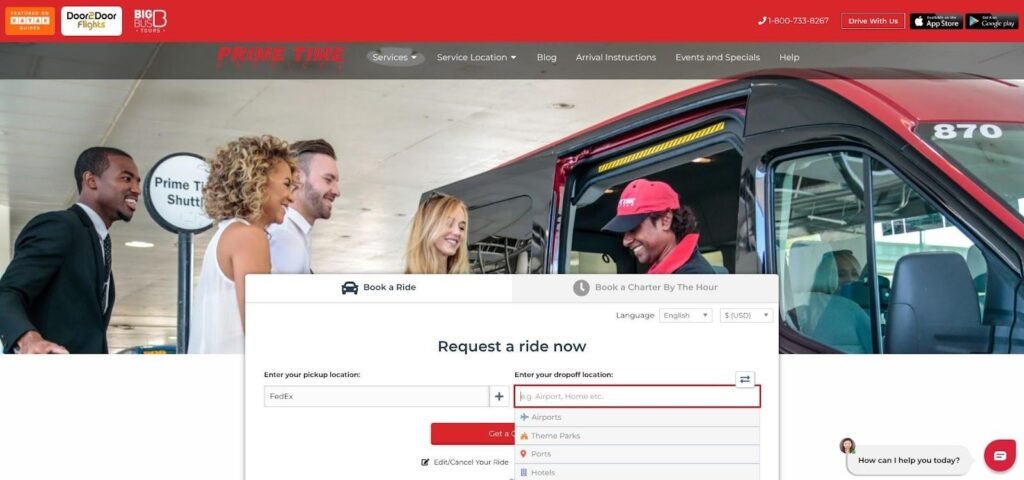
Prime Time Shuttle fare quote and live tracking interface for hotel guests
Compliance is partly documented. Prime Time holds California Public Utilities Commission authority PSG0019866 and publishes “thorough background checks on all drivers, including inquiries on their criminal background and their driving history”, plus safety and defensive-driving training. It does not publish a drug-testing program or its motor-vehicle-record cadence, so ask for both. The other open question is the service model: Prime Time sells several tiers, from shared ride to Express sedan to private van, so your contract must state which one serves the hotel, or you might receive a sedan instead of a branded van.
Reputation is mixed. The iOS app averages 3.5 out of 5 across 248 ratings on Apple’s App Store, and the company’s Trustpilot profile carries recurring complaints about last-minute cancellations, missed pickups and refunds. That record trails every other finalist on this list, so add on-time guarantees and financial penalties to the service level agreement.
Prime Time suits select-service hotels that need upfront pricing, mobile booking, and quick guest quotes. Lock in the commercial fleet, confirm insurance limits, and tie payments to measurable performance.
What California hotels must verify before signing a shuttle contract
Paperwork that looks clean on bid day can hide gaps that surface at the curb. Work through this audit in order and you will surface the gaps that most often derail a shuttle program before they reach the curb.
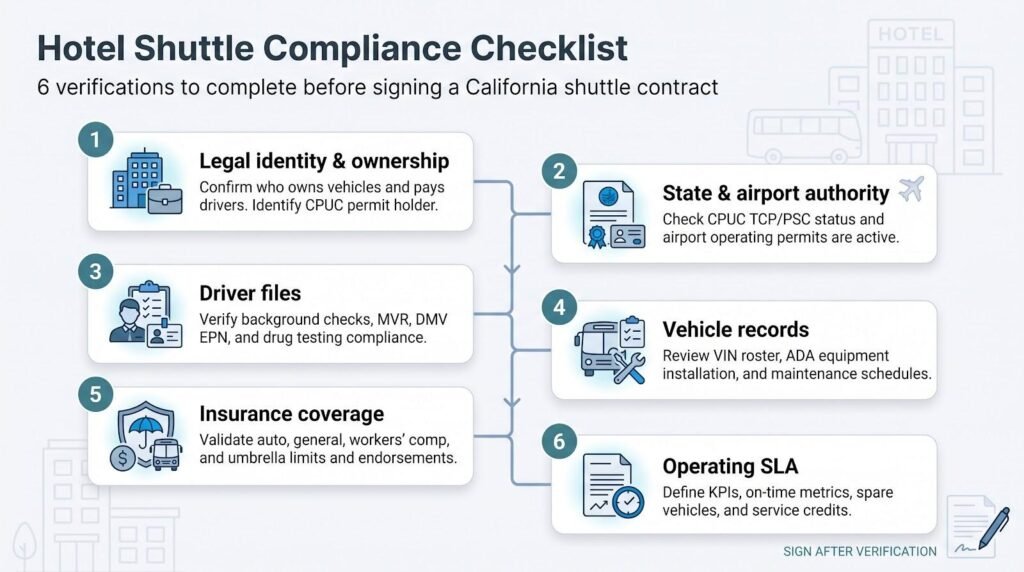
1. Legal identity and ownership
- Who owns each vehicle?
- Who pays each driver?
- Who holds the CPUC authority?
If the rep says “we partner with local carriers,” ask for a full subcontractor list and matching insurance certificates.
2. State and airport authority
Look up the carrier’s TCP or PSC number in the CPUC database and confirm “Active” status, current insurance filing, and no recent suspensions. Repeat for every airport permit; LAX and SFO can eject vehicles operating on expired credentials.
3. Driver files
Request proof of background checks, MVR review, DMV Employer Pull Notice enrollment (ask who gets alerts and how quickly a flagged driver is removed), and both pre-hire and random drug tests, along with the annual test percentage.
4. Vehicle records
Ask for a VIN roster that lists seating capacity, ADA equipment, and odometer. Attach the latest CHP terminal-inspection or BIT report, the preventive-maintenance schedule, and any Clean Truck Check submissions. For EV fleets, add charger locations and a power-outage contingency.
5. Insurance
Do not accept “fully covered.” Require certificates showing auto, general, workers’ comp, and umbrella limits. Many hotels specify $10 million auto liability and list the property as additional insured, primary and non-contributory, with waiver of subrogation.
6. Operating SLA
Define on-time pickup, headway tolerance, spare-vehicle response time, and monthly KPI reporting. Tie misses to service credits or liquidated damages.
How to verify a California shuttle company in three quick moves
- CPUC lookup: Enter the legal name or TCP number, then screenshot “Active” status, “Insurance on file,” and any enforcement notes.
- Safety data: Check the latest CHP inspection or FMCSA SAFER snapshot for out-of-service rates and open corrective actions.
- Airport list: Each major hub (LAX, SFO, SAN, SNA, ONT) posts an authorized-carrier list. Make sure the exact legal entity appears on every list that matches your route map.
Run these three checks during RFP, again before launch, and quarterly thereafter. Ten minutes online now beats a 4 am scramble when a driver gets turned away at the gate.
What hotel shuttle contracts really cost
A low hourly rate can hide expensive variables. Before signing, convert every proposal into three comparable numbers: total annual operating hours, cost per hour, and cost per passenger based on your occupancy history.
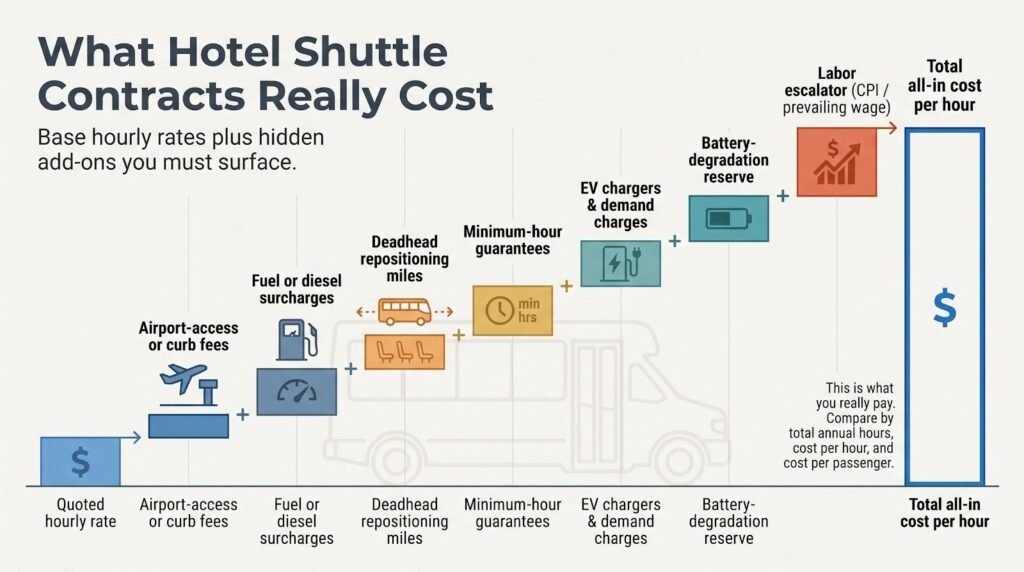
Typical add-ons to surface:
- Airport-access or curb fees that rise each fiscal year
- Fuel or diesel surcharges pegged to federal indexes
- “Deadhead” repositioning miles between trips
- Minimum-hour guarantees that bill idle time between flight banks
Electric fleets add new cost lines such as charger installation, utility demand charges, and battery-degradation reserves. Ask for these figures up front and cap them to actual energy use, not flat fees.
Labor is the final swing factor. California’s continuing driver shortage keeps wages climbing; most contracts now include an escalator tied to the Consumer Price Index or prevailing-wage tables. Define the formula today so next year’s bump does not surprise finance.
Run this math before you commit. The cheapest rate on paper often becomes the priciest invoice once every hidden variable shows up.
California shuttle trends hotels should plan for
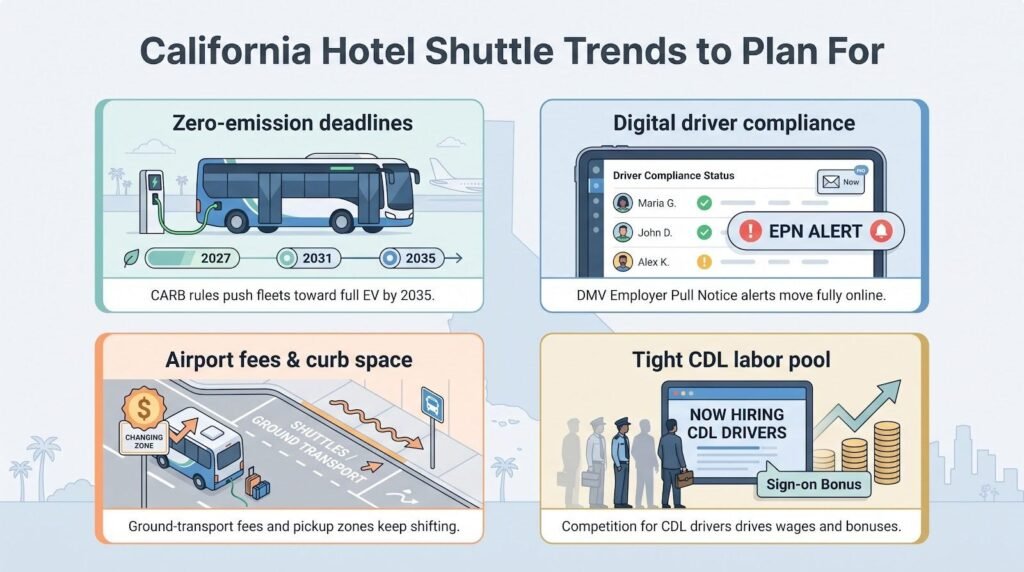
- Zero-emission deadlines are locked in. CARB’s Zero-Emission Airport Shuttle rule requires fleets at the 13 regulated airports to reach 33 percent electric by December 31, 2027; 66 percent by 2031; and 100 percent by 2035. Utilities warn that new transformers can take years to install, so late adopters pay rush pricing for both hardware and power.
- Driver compliance is now digital. As of April 1, 2026, the DMV requires every Employer Pull Notice account to upload driver rosters, receive alerts, and pay invoices online. Insurers see timestamped alerts; hotels that delay removing a suspended driver risk negligence claims.
- Airport fees and curb space keep moving. In March 2026 the Los Angeles World Airports board approved its first rideshare and taxi fee increase in more than a decade, taking terminal-curb pickups to 12 dollars once the Automated People Mover opens, and San Francisco International continues to shuffle pickup zones. Build contract language that lets you renegotiate routes and recover new fees with 30 days’ notice.
- The CDL labor pool is tight. Shuttle companies compete with delivery, transit, and construction fleets. Signing bonuses and CPI-linked wage clauses are common. Add a clear escalator formula to multi-year deals to avoid mid-contract service gaps.
Conclusion
Six carriers, one shortlist, and a single test that separates them: what can you verify today? Mosaic and Transportation Charter Services publish an authority number you can look up in minutes. Prime Time publishes fares. FC Parking publishes the continuous driver monitoring that is hardest for a hotel to audit on its own, and bundles shuttles with valet and parking so you are not managing two vendors at one curb. Whichever way you lean, run the three checks in the section above during the request for proposal, again before launch, and quarterly after that. The four forces reshaping this market, electric conversion, digital compliance, airport-access volatility and labor scarcity, all reward the property that wrote verification into the contract rather than the one that trusted the brochure.
Frequently asked questions
Do California hotel shuttle companies need a CPUC license?
Yes. Any for-hire operator that moves guests off hotel property must hold an active charter-party carrier (TCP) or passenger stage corporation (PSC) certificate.
What is the difference between TCP, PSC, and PCP authority?
- TCP - Charter or on-demand routes
- PSC - Fixed, published schedules open to the public
- PCP - Private Carrier of Passengers, a Department of Motor Vehicles certificate rather than a Public Utilities Commission one. Note the exemption that matters to you: under California Vehicle Code section 34681, a hotel that runs its own vehicles to terminals or attractions without a separate charge is exempt, so the certificate question usually lands on your vendor rather than on you.
Your contract must cite the correct class, or the insurance filing will not match the risk.
Is an airport permit enough?
No. Airport ground-transport permits sit on top of state authority; they never replace it.
How often should licenses be rechecked?
At least quarterly. CPUC authority can lapse without notice, and airport permits renew on their own cycles.
Are shuttle drivers required to undergo background checks?
Commercial-license checks are mandatory; criminal screening is employer policy. Require county, federal, and sex-offender searches with a seven-year look-back.
What is the Employer Pull Notice (EPN) program?
EPN is the DMV system that emails employers when an enrolled driver’s record changes. Since April 1, 2026, all alerts are digital, so any delay in removing a suspended driver is harder to defend.
How often should drivers be drug tested?
Testing is not a nice-to-have in California. The Public Utilities Commission requires anyone applying for charter-party or passenger stage authority to run a controlled substance and alcohol testing program covering pre-employment, random and post-accident testing. For drivers under federal commercial rules, the random rate for controlled substances is 50 percent of covered positions a year and 10 percent for alcohol, and it has been at that level since 2020. Ask each vendor for its pool size and its actual completed-test count last year, not just its policy.
How much insurance should a hotel require?
CPUC sets a $5 million auto-liability minimum for high-capacity vehicles, but many brands require $10 million plus $2 million to $5 million in excess coverage.
Does a hotel shuttle need to be ADA accessible?
If the route is open to the public, equivalent wheelchair access is legally required. Even for private routes, ADA lifts are a smart practice.
What documents belong in an RFP response?
Active CPUC certificate, airport permits, insurance COIs, driver-screening policy, EPN proof, VIN roster, maintenance logs, and a sample KPI report.
How much does an outsourced hotel shuttle cost?
There is no reliable public rate card, because pricing turns on hours, vehicle class, driver wages in your market and how much idle time you are willing to guarantee. Use a published anchor instead: hospitality operators have put the cost of running a single shuttle van in-house at roughly 150,000 to 175,000 dollars a year, so convert every bid into annual operating hours, cost per hour, and cost per passenger, and compare against that. Ask for charging infrastructure to be priced as a separate line for electric fleets rather than folded into the hourly rate.
What happens if the provider uses subcontractors?
The prime contractor remains liable only if your contract says so. Require written approval for every sub and collect each entity’s authority and insurance documents.
Recommended Stories for You

Startuprise Jun 4, 2026

What to Consider Before Choosing a Modern Luxury Stay in Goa for a Perfect Coastal Experience
Startuprise Jun 10, 2026

Startuprise Jun 23, 2026

Startuprise Apr 2, 2026
Startuprise May 19, 2026
Startuprise Jul 4, 2026
Trending Stories

7 Signs You Need a Financial Advisor in Singapore

Tips to find a broker in Asia

The Future of Group Health Insurance: Trends and Best Practices
Why Rent Car Dubai Is the Smartest Mobility Choice for Startups, Entrepreneurs, and Business Professionals

Practical Ideas to Use Custom Badges to Promote Your Business
How to Choose the Right Insurance Policy When Considering 1 Crore Term Insurance
Video localization: a first-market playbook for Asian startups

Talent Mapping How Recruiters Build Better Candidate Pipelines Before Hiring Begins