


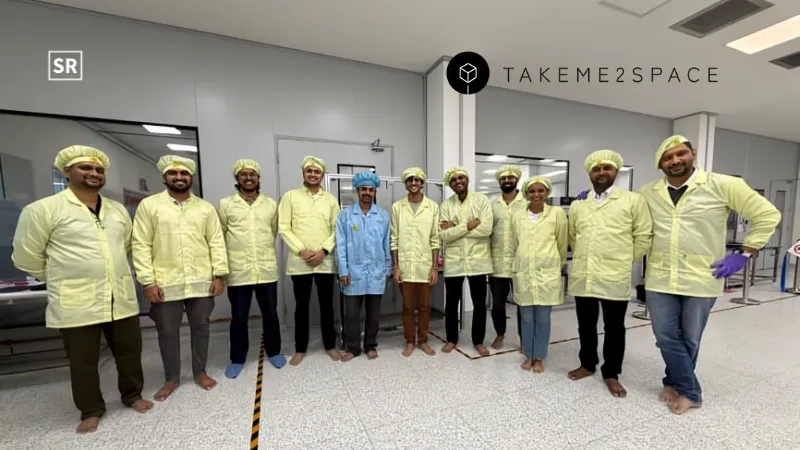
Hyderabad-based space tech startup TakeMe2Space has raised $5 million in a seed funding round led by Chiratae Ventures, with support from Unicorn India Ventures, Artha Venture Fund, and SeaFund.
The company will use this money to expand its satellite network to six satellites, improve real-time AI processing in space, and speed up research on high-power computing satellites.
TakeMe2Space also plans to grow its operations in India, the US, and Australia. In the next phase, it aims to connect its satellites using optical links and start with about 5 kilowatts of computing power in orbit.
The company’s long-term goal is to build AI-powered data centers in space. It believes this can reduce costs by 5 to 8 times for industries such as agriculture, mining, logistics, and environmental monitoring.
Before this funding round, the Hyderabad-based startup had raised $629.5K in pre-seed funding last year. It was also featured in Inc42’s “30 Startups To Watch” list in June 2025.
“2026 has started with the launch of MOI-1, our first major satellite powering OrbitLab. I am excited for the next phase where we will grow from a single satellite based solution to a networked satellite based solution,” said founder Ronak Kumar Samantray. He added that the constellation will help customers receive near real-time compute services from space.
Ranjith Menon, managing director, Chiratae Ventures, said “TakeMe2Space is fundamentally reimagining things by turning satellites into shared, programmable infrastructure, and we have immense conviction in Ronak and the team’s ability to execute this vision’’. He added that the company’s unique fractional ownership model and in-space processing capabilities make space native compute broadly accessible.
TakeMe2Space was founded in 2024 by Ronak Kumar Samantray. The startup builds AI computing systems in Low Earth Orbit to process data directly in space. Its “Made-in-India” satellites let users upload AI models and run them in space through its OrbitLab platform, at a cost of $2 per minute.
The company said that during its MOI mission, it became the first to upload large AI models from Earth to a satellite, run outside software on the satellite, and safely send back encrypted results. It also tested a special radiation-protection coating in space, which helps satellites last longer and allows the use of regular electronic components.
Read More- Fabpad Secures Funding in Seed Round Led by Inflection Point Ventures
