


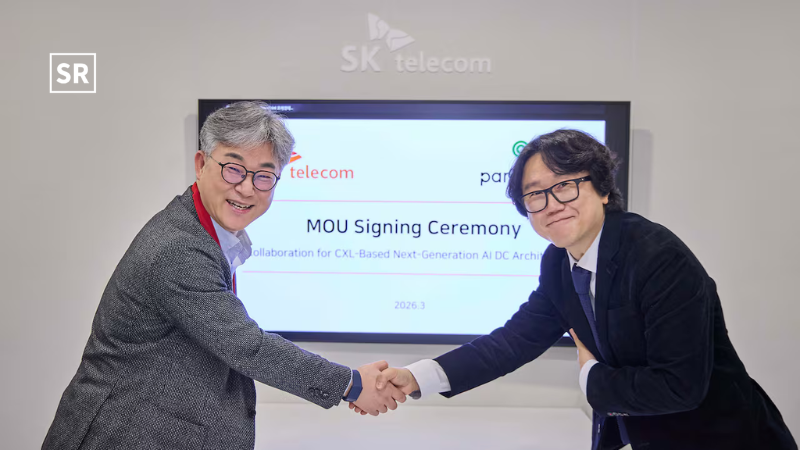
South Korean telecom company SK Telecom and AI infrastructure solutions provider Panmnesia have signed a memorandum of understanding (MoU) at Mobile World Congress 2026 in Barcelona.
They will work together to develop a Compute Express Link (CXL)-based AI data centre architecture to improve efficiency and performance in next-generation AI data centres.
The partnership will use CXL technology to separate and flexibly connect CPUs, GPUs, and memory at the rack level. It will use CXL Fabric Switches and “Link Controllers” instead of traditional server-based or network-based systems.
This setup allows unused computing resources — especially memory and GPUs — to be shared across servers. As a result, data centres can reduce waste and improve performance without adding more hardware.
“SK Telecom is committed to expanding its role in the AIDC business and evolving into a comprehensive AIDC developer overseeing the entire AIDC project — including design, construction and operation. AI infrastructure is a core driver of both corporate and national competitiveness. As Korea’s leading AI company, SK Telecom will work hand in hand with the government to achieve Global Top 3 status in AI,” states Jung Jaihun, CEO, SK Telecom.
Suk Geun Chung, Head of AI CIC at SKT, stated, “The competitiveness of AI DC now extends beyond GPU performance alone and depends on system-level optimization encompassing memory and data flow. This collaboration will help alleviate the structural bottleneck known as the ‘Memory Wall,’ where data movement and supply cannot keep pace with increasing computational performance thereby enhancing both the performance and economic efficiency of AI DC.”
Myoungsoo Jung, CEO of Panmnesia, said, “Next-generation AI infrastructure will be defined not by the performance of individual devices, but by the architecture created through diverse link semiconductors. Together with SKT, we aim to present a high-efficiency AI DC model that will set a new standard in the global market.”
By replacing traditional network-based GPU operations (often done using Ethernet) with direct CXL links, the companies aim to reduce extra data copying and software involvement. This will help lower delay and power use, while making data movement more efficient.
Panmnesia’s technology includes PCIe 6.0/CXL 3.2 Fabric Switch chips that fully support the CXL 3.2 standard. These switches use port-based routing, allowing flexible, mesh-like connections that enable shared and composable computing across racks.
SK Telecom is rapidly expanding in the AI data center space. It plans to build a 1 GW-scale AI data center and buy thousands of NVIDIA GPUs to strengthen its AI computing infrastructure. If successful, the new CXL-based system could place SK Telecom and Panmnesia among the leaders in next-generation AI data center technology.
Read also- myFirst raises US$8 million Series A round Vertex Ventures
