

HydroSight Raises $5 Million to Use AI for Smarter Seabed Mapping and Marine Data
Sep 8, 2026 | By Nguyen Minh
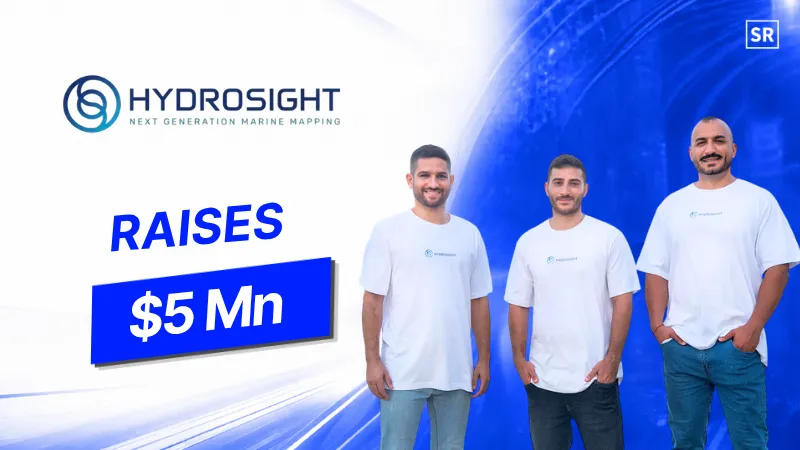
Haifa-based startup HydroSight has come out of stealth mode after raising $5 million in Seed funding. The company is developing an AI-powered platform that helps map and better understand the seabed.
SUMMARY
- HydroSight, a Haifa-based startup, has raised $5 million in Seed funding.
- The round was led by StageOne Ventures, with participation from Vertex Ventures and the National Center of Blue Economy.
- Founded in 2025, HydroSight aims to make underwater data easier to understand and reduce the manual work involved in seabed mapping.
 Follow us
 Follow us
The funding round was led by StageOne Ventures, with additional investment from Vertex Ventures and the National Center of Blue Economy, which operates under the HiCenter Ventures investment fund.
“Beneath the surface of the sea lies a vast world we still know very little about, even though a significant part of our lives already depends on it,” Adler said. “Roughly 30% of the world’s oil and gas is produced at sea, and more than 99% of international data traffic runs through cables laid on the seabed.”
“In the coming years, with the shift to clean energy, growing density along coastlines and the need for more marine infrastructure, we will depend on this world even more,” he added. “We founded HydroSight to help the world better understand what’s happening beneath the sea’s surface, and to enable more precise, intelligent and sustainable development of the underwater environment.”
RECOMMENDED FOR YOU



HydroSight was founded in late 2025 by Tomer Adler (CEO), Haitham Ezzy (CTO), and Chen Megera (COO). The three founders have strong experience in the marine industry.
They understand the challenges of working with underwater data because of their hands-on experience on vessels and in maritime operations. This experience helped them build HydroSight’s technology for understanding the seabed.
HydroSight was created to solve a problem the founders had seen themselves. Sonar systems and modern marine technologies can now collect huge amounts of data about the seabed.
However, turning all this data into a clear and updated picture of the seabed still takes a lot of manual work. It also requires people with specialized knowledge and experience.
Read Also- Dawraty Raises $2 Million Seed Funding at $10M Valuation to Expand Across the Region
Recommended Stories for You
Nguyen Minh Jul 11, 2026
Yan li Nov 6, 2025

Yan li Aug 26, 2025


Team SR Aug 2, 2024
Trending Stories
[Funding Alert] UAE-Based Shorages Secures $1 Million in Pre-Series A Funding
Pay.com.au Secures $25M Funding, Valued at $633 Million

UAE-based Dubizzle acquires Egyptian Hatla2ee

Hong Kong’s Robocore Secures Up to $30M Investment from Foxconn
Israel-based Vayu Raises $7 Mn in Seed Funding

Fabheads Secures $10 Million in Series A Funding Led by Accel

Israel-based AutonomyAI Secures $4 Million in Seed Funding

[FUNDING NEWS] Saudi Arabia-Based SaaS provider Merit Secures $12 Million in Pre-Series B Funding