

PFN and Tenstorrent Selected for Japan’s Five-Year xPU Research Project
Oct 22, 2026 | By Carmela Catilo
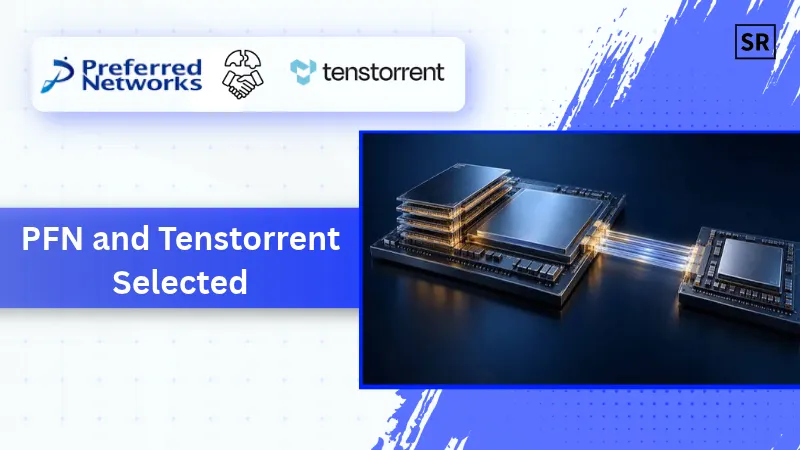
Japan’s Preferred Networks (PFN) and AI-chip developer Tenstorrent have been selected for a five-year government-backed research project to develop an advanced computing platform designed for next-generation artificial intelligence (AI) and high-performance computing applications.
 Follow us
 Follow us
The project is part of an initiative administered by Japan’s New Energy and Industrial Technology Development Organization (NEDO) under its post-5G information and communications infrastructure program. NEDO announced the selected implementation structure on October 20, 2026.
What Will PFN and Tenstorrent Develop?
The two companies will lead different parts of the processor development effort, combining their expertise in AI computing and open processor architecture.
- Preferred Networks (PFN): Will lead the development of AI chiplets, including designs that incorporate three-dimensional memory stacking to support data-intensive computing workloads.
- Tenstorrent: Will develop open-architecture CPU chiplets based on its processor technology, with support for confidential computing to help protect sensitive data during processing.
The project aims to connect these specialized components into a scalable computing platform. By developing processors, memory, and interface components separately, the chiplet approach could provide greater design flexibility than conventional single-chip architectures.
RECOMMENDED FOR YOU


Universities and Research Organizations to Participate
The project will also involve several academic institutions and research organizations as subcontractors. These include the University of Tokyo, Kobe University, Toyo University, the Japan Agency for Marine-Earth Science and Technology, the Japan Atomic Energy Agency, and Tenstorrent Japan.
Their participation is expected to bring together expertise in semiconductor engineering, computer architecture, security, and scientific computing.
The research could also benefit from demanding computing applications in areas such as marine science and nuclear-energy research, where performance, reliability, and data protection are important considerations.
Why Is the xPU Project Important for AI Computing?
As AI models grow in size and complexity, computing systems face increasing demands for memory bandwidth, processing capacity, and energy efficiency. Conventional processor architectures can encounter limitations when moving large volumes of data between processors and memory.
The combination of chiplets, advanced packaging, and optical interconnects could help address these challenges by enabling more flexible system designs and more efficient communication between computing components.
Tenstorrent’s Recent Funding and PFN’s Technology Background
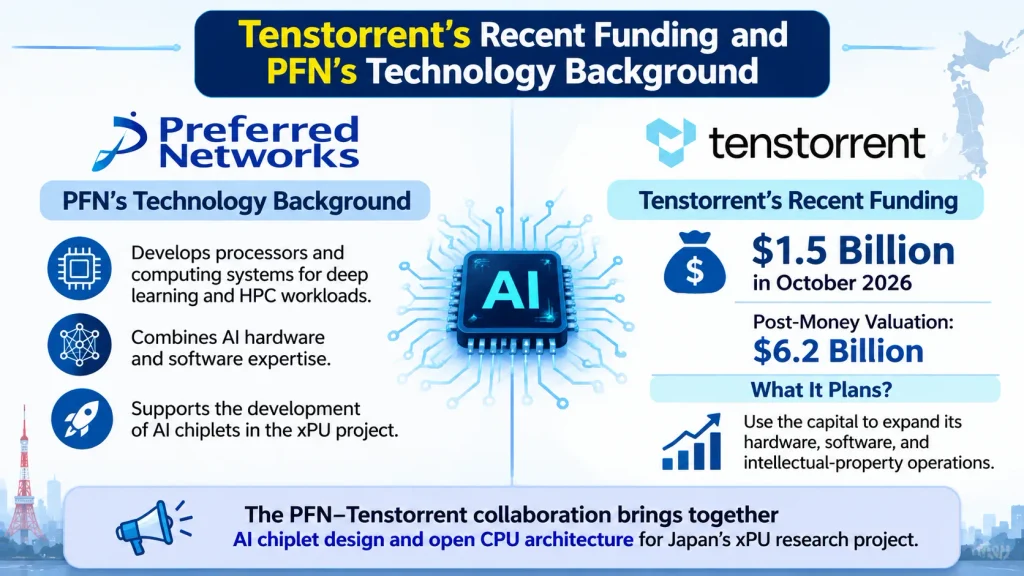
The research selection follows Tenstorrent’s October 2026 financing round, in which the company raised $1.5 billion at a reported post-money valuation of $6.2 billion. The company plans to use its capital to expand its hardware, software, and intellectual-property operations.
However, the financing round is separate from the NEDO research project. The companies have not disclosed the project’s funding amount or identified a specific portion of Tenstorrent’s recent investment for this collaboration
What Happens Next?
The project establishes a research framework, but several technical and commercial details remain undisclosed. The announcement did not specify a target manufacturing process, foundry partner, prototype performance figures, commercialization date, or project funding amount.
The participating organizations will need to demonstrate that the separate chiplets and interconnect technologies can work together efficiently, be manufactured reliably, and support practical software workloads.
Read Also - Onto Closes $1 Mn to Make Travel More Affordable and Expand Its Platform
Recommended Stories for You

Yan li Sep 9, 2025
Nguyen Minh Sep 26, 2026

Team SR Aug 26, 2024

Team SR Oct 23, 2024


Nguyen Minh Jan 3, 2024
Trending Stories

Singapore-based CBC-Backed Hasten Biopharmaceutical Aquires 14 Celltrion Legacy Products

MEEZA Raises $219M Murabaha Financing to Boost Qatar Data Center Capacity

QIA to launch USD 1 billion Fund of Funds Venture Capital Program

IFC Extends Partnership with CIB to Strengthen Egypt’s Financial Sector and Small Businesses

Yinson GreenTech’s chargEV Collaborates with eLoaded

Soter Insure Raises Series A Funding to Expand Digital Asset Insurance Solutions

Respiree from Singapore Raises $11.6M in Series A Funding Led by We Venture Capital and ClavystBio

Vividobots Raises INR 1.47 Crores in Seed Round Led by Inflection