
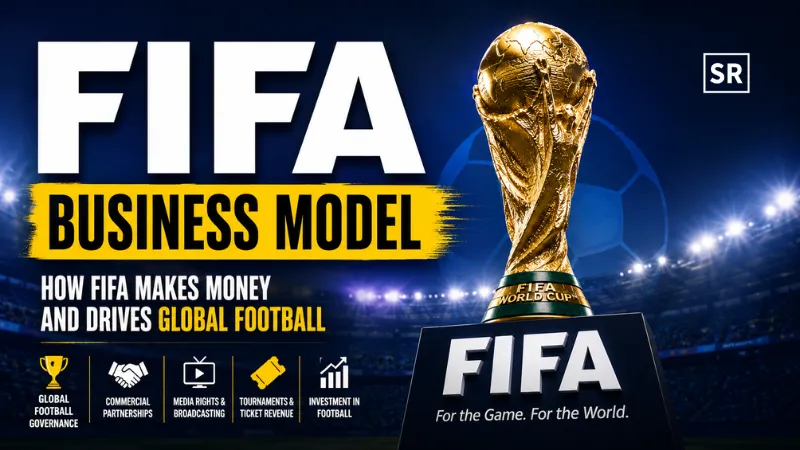
FIFA Business Model: How FIFA Makes Money From the World Cup
Aug 22, 2026 | By Nguyen Minh
 Follow us
 Follow us
The FIFA World Cup is easy to understand as a sporting event. Every four years, national teams compete for football’s biggest prize, millions of fans follow the matches, and one country lifts the trophy.
FIFA has built a global commercial ecosystem around one of the world’s most valuable sports properties. Instead of depending on a single source of income, it monetizes the World Cup through broadcasting rights, sponsorships, ticketing, hospitality, licensing, merchandise and other commercial rights.
And 2026 is a particularly important year for that model. The World Cup expanded from 32 to 48 teams, with 104 matches being played across Canada, Mexico, and the United States. FIFA describes the 2026 tournament as its biggest World Cup yet.
So, how does the FIFA business model actually work? Let’s break it down in simple terms.
What Is FIFA’s Business Model?
FIFA’s business model is essentially built around owning, managing, and monetizing football’s most valuable global intellectual property.
The organization doesn’t need to manufacture a product like a consumer-goods company. Instead, FIFA creates and controls competitions that attract enormous audiences.
FIFA creates the tournament and controls many of the commercial rights surrounding it. Broadcasters pay to show the matches. Sponsors pay to associate their brands with the tournament. Fans pay for tickets and hospitality. Licensees sell official merchandise.
One event, therefore, creates several different revenue streams.
FIFA Business Model at a Glance
| Business Model Component | How FIFA Creates Value |
| Core Asset | FIFA World Cup brand and football intellectual property |
| Customers | Broadcasters, sponsors, fans, licensees and hospitality buyers |
| Main Product | World Cup competitions and associated commercial rights |
| Media Revenue | Television and streaming rights |
| Marketing Revenue | Sponsorships and advertising partnerships |
| Consumer Revenue | Tickets, hospitality and merchandise |
| Licensing Revenue | Licensed products and commercial uses of FIFA IP |
| Distribution | Television, streaming, stadiums, digital platforms and retail |
| Key Advantage | Global audience, scarcity and exclusive sports IP |
RECOMMENDED FOR YOU


How Does FIFA Make Money?
FIFA’s revenue model has several major components.
1. Broadcasting Rights
Broadcasting is one of FIFA’s biggest money-making machines.
FIFA sells rights to broadcasters that want to show World Cup matches in specific countries or territories.
Why are broadcasters willing to pay so much?
Because the World Cup delivers something extremely valuable: a huge audience that actively wants to watch live content.
Broadcasters make money through:
- Advertising
- Sponsorship
- Streaming subscriptions
- Premium television packages
- Digital content
- Highlights and related programming
2. Sponsorship and Marketing Rights
The second major part of the FIFA revenue model is sponsorship.
Global brands want to be associated with the World Cup because football gives them access to an enormous international audience.
FIFA sells different commercial rights and sponsorship packages, allowing companies to associate themselves with the tournament through:
- Stadium branding
- Television exposure
- Digital campaigns
- Social media
- Promotional campaigns
- Official tournament content
- Hospitality
- Consumer activations
The attraction for sponsors isn’t simply putting a logo on a screen.
They’re buying a connection with an event that already has emotional importance to millions of people.
FIFA’s 2025 financial reporting also shows marketing rights as a distinct revenue category, reflecting how important commercial partnerships are to its overall model.
Why sponsorship works so well for FIFA
The World Cup has something many businesses struggle to create:
scarcity.
It happens only once every four years.
That makes being an official World Cup partner a much more exclusive proposition than buying ordinary advertising space.
3. Ticket Sales
Ticketing is another main source of revenue. In 2026, the opportunity is particularly large because the tournament features 104 matches across 16 host locations.
Every match creates seating inventory.
That inventory can be sold at different price points, depending on:
- Match
- Location
- Seating category
- Demand
- Stage of the competition
- Premium positioning
The business principle here is simple:
A seat is not just a seat. It is a piece of scarce inventory.
A highly anticipated knockout-stage match can command a very different price from an early group-stage game.
4. Hospitality
Hospitality takes ticketing to another level.
Instead of simply buying admission to a match, customers can purchase premium experiences.
These may include:
- Premium seats
- Private suites
- Corporate hospitality
- Food and beverage services
- Exclusive lounges
- Client entertainment
- Premium match-day experiences
The FIFA World Cup 2026 hospitality program offers packages across the tournament’s 104 matches and 16 venues.
This is an important part of the FIFA business model because premium customers can generate significantly more revenue than ordinary ticket buyers.
It also creates a B2B opportunity.
Companies can use hospitality to entertain customers, reward employees, or build relationships with business partners.
5. Licensing
FIFA doesn’t make every product itself. Instead, it provides licenses to its intellectual property.
It provides licenses to different products, which can include:
- Apparel
- Jerseys
- Footballs
- Collectibles
- Accessories
- Games
- Souvenirs
- Other World Cup merchandise
The official FIFA store, for example, sells World Cup apparel, accessories, and tournament merchandise.
The advantage of licensing is that FIFA can monetize its brand without having to operate every part of the manufacturing and retail chain.
The licensee takes care of much of the production and distribution. FIFA monetizes the brand and intellectual property.
6. Merchandise
Merchandise is closely connected to licensing, but it deserves separate attention. Fans don’t just watch the World Cup. They want experience and feel connected to their favourite team or sportsman.
They buy:
- Team jerseys
- World Cup shirts
- Caps
- Scarves
- Footballs
- Collectibles
- Souvenirs
- Tournament memorabilia
This creates another opportunity to turn emotional engagement into commercial activity.
And because the World Cup is temporary and highly memorable, merchandise can benefit from the tournament’s limited-time nature.
7. Digital Revenue and Fan Engagement
The FIFA business model is no longer limited to television and stadiums.
Digital platforms have become an important part of the organization’s relationship with fans.
FIFA can use digital channels to distribute:
- Match information
- Videos
- Highlights
- Statistics
- News
- Interviews
- Tournament content
- Fan experiences
The advantage is that digital platforms allow FIFA to remain connected with its audience before, during, and after the actual tournament.
That gives the World Cup a much longer commercial life than the 90 minutes played on the pitch.
FIFA’s 2026 Revenue Strategy
FIFA’s own financial documents show just how large this commercial cycle has become.
FIFA revised its revenue target for the 2023–2026 cycle to $13 billion.
Importantly, that figure refers to the broader four-year FIFA cycle, not simply money generated from World Cup match tickets.
This distinction matters.
The World Cup is the main commercial engine, but FIFA’s overall financial activity covers more than the men’s World Cup alone.
Its ecosystem includes other competitions, commercial rights, and football-related activities.
FIFA Business Model Canvas
A simple Business Model Canvas makes the structure easier to understand.
| Element | FIFA’s Business Model |
| Key Partners | Broadcasters, sponsors, host cities, national football associations, licensees, hospitality providers |
| Key Activities | Organizing competitions, managing commercial rights, marketing, broadcasting and brand management |
| Key Resources | FIFA brand, World Cup IP, global football network and audience |
| Value Proposition | Access to one of the world’s most recognizable sporting events |
| Customer Segments | Fans, broadcasters, sponsors, advertisers, hospitality customers and licensees |
| Customer Relationships | Long-term commercial partnerships and global fan engagement |
| Channels | Television, streaming, stadiums, digital platforms and retail |
| Revenue Streams | Broadcasting, marketing, tickets, hospitality, licensing and other income |
| Cost Structure | Tournament operations, technology, staffing, security, logistics, prize-related commitments and administration |
The interesting part is that FIFA’s most valuable asset isn’t a physical object. It’s intellectual property plus audience attention.
FIFA’s Key Partnerships
FIFA cannot operate the World Cup alone. Its business model depends on a large network of partners.
- Broadcasters
- Sponsors
- Host Cities
- National Football Associations
- Licensees
- Hospitality Companies
Conclusion
FIFA's business model (2026) is the best example of how valuable intellectual property can be transformed into a global commercial ecosystem.
The expanded 48-team format and 104-match tournament provide more content and inventory, while FIFA’s established brand gives broadcasters, sponsors, fans, and commercial partners a reason to participate.
The biggest lesson isn’t that every business should try to copy FIFA. It’s that businesses should look beyond their primary product.
Recommended Stories for You
Nguyen Minh Jun 12, 2026

Yan li Mar 28, 2026
Nguyen Minh Jul 24, 2026

Nguyen Minh Jul 13, 2026
Trending Stories
Franchise business in Vietnam 2025

Motherhood Malaysia’s – Leading Parenting & E-commerce Platform

How to Start an E-Commerce Business in Singapore: A Complete Guide

New Software Wuvdbugflox Overview: A Modern Tool for Smarter Workflows and Productivity

5 Best MBA Programs for Tech Jobs

How to Calculate Overtime Pay in Malaysia: A Step-by-Step Guide
Autohome Aims to Revolutionize Car Buying Worldwide with AI

Zero-cost, No-code Checklist for Pre-launch Startups: Build Your Dream Business with Zero Investment