

Nvidia vs AMD: Which GPU and AI Platform Is Right for You?
Oct 1, 2026 | By Nguyen Minh
 Follow us
 Follow us
Nvidia and AMD are two of the most important names in modern computing, and their rivalry has become much bigger than traditional graphics cards.
Both companies make GPUs for gaming and professional workloads, but they have taken somewhat different paths. Nvidia has built a broad accelerated-computing platform around its GPUs, CUDA software, AI systems, and networking. AMD combines Radeon graphics with Ryzen CPUs, EPYC server processors, Instinct AI accelerators, and its ROCm software platform.
The differences become especially noticeable when you move from gaming to AI.
For the everyday buyer, however, the choice is often much simpler: compare the specific GPUs you can afford, the games or software you use, and the features which actually matter to you.
Nvidia vs AMD: Quick Comparison
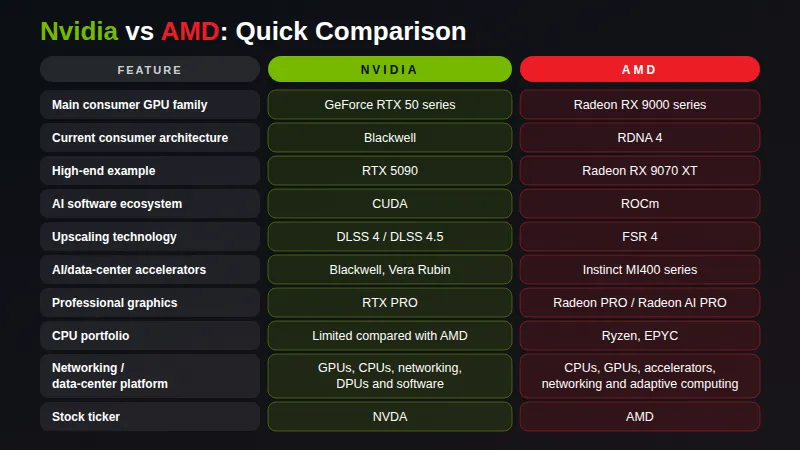
| Feature | Nvidia | AMD |
| Main consumer GPU family | GeForce RTX 50 series | Radeon RX 9000 series |
| Current consumer architecture | Blackwell | RDNA 4 |
| High-end example | RTX 5090 | Radeon RX 9070 XT |
| AI software ecosystem | CUDA | ROCm |
| Upscaling technology | DLSS 4 / DLSS 4.5 | FSR 4 |
| AI/data-center accelerators | Blackwell, Vera Rubin | Instinct MI400 series |
| Professional graphics | RTX PRO | Radeon PRO / Radeon AI PRO |
| CPU portfolio | Limited compared with AMD | Ryzen, EPYC |
| Networking/data-center platform | GPUs, CPUs, networking, DPUs and software | CPUs, GPUs, accelerators, networking and adaptive computing |
| Stock ticker | NVDA | AMD |
What Is Nvidia?
Nvidia is a semiconductor and computing company best known for its GPUs, but its business today goes well beyond graphics cards.
The company describes itself as a pioneer in accelerated computing and has expanded into AI infrastructure, networking, professional visualization, robotics, and other areas. Its data-center platform combines GPUs with CPUs, networking products, software, and systems designed for large-scale AI workloads.
For consumers, the GeForce RTX family is Nvidia’s best-known product line. The current RTX 50 series is built on the Blackwell architecture and includes features such as fifth-generation Tensor Cores, fourth-generation ray-tracing cores, and DLSS technology.
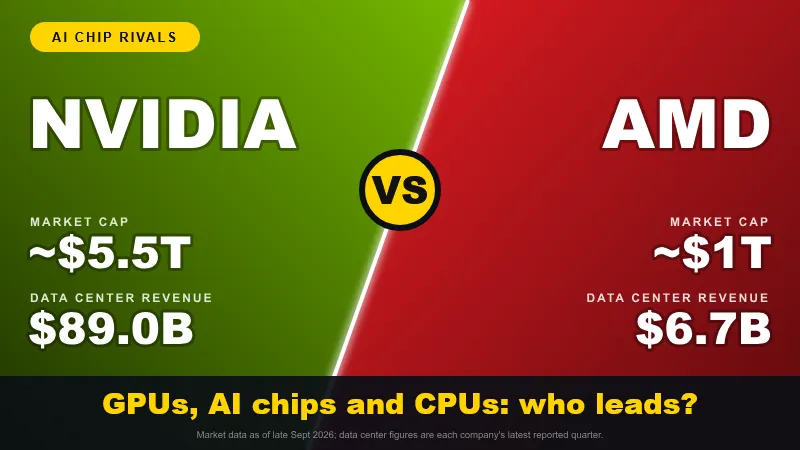
Nvidia’s biggest business opportunity in recent years has been AI computing. Nvidia generated $96.2 billion in revenue in the most recent quarter.
What Is AMD?
AMD, or Advanced Micro Devices, is another major semiconductor company, but its product portfolio is particularly broad.
It develops Ryzen processors for PCs, EPYC processors for servers, Radeon graphics, Instinct AI accelerators, adaptive computing products, networking technologies, and related software.
For desktop gaming, AMD’s Radeon RX 9000 series uses the RDNA 4 architecture. The Radeon RX 9070 XT, for example, has 16GB of GDDR6 memory, 64 compute units, and 128 AI accelerators.
AMD also has a growing data-center AI business. Its Q2 2026 Data Center revenue reached $6.7 billion, up 107% year over year, driven by EPYC processors and Instinct GPUs.
Nvidia vs AMD: Key Differences
The biggest difference is not simply the GPU hardware. It is the ecosystem surrounding that hardware.
Nvidia has spent years building CUDA, developer tools, libraries, AI frameworks, networking products, and complete data-center systems around its GPUs. CUDA provides the compiler, libraries, and developer tools used to build GPU-accelerated applications.
AMD takes a different approach with ROCm, an open software stack that includes compilers, runtimes, libraries, debuggers, profilers, and other tools for programming AMD GPUs.
There is also a major difference in overall product strategy. AMD operates significant CPU, GPU, server, embedded, FPGA, and adaptive-computing businesses, while Nvidia’s current strategy is strongly centered on accelerated computing and AI infrastructure.
Nvidia vs AMD GPUs
The consumer GPU battle is where most PC buyers encounter the two companies.
Nvidia’s RTX 50 series includes the RTX 5090, RTX 5080, RTX 5070 Ti, RTX 5070, RTX 5060 Ti, RTX 5060, and other models. Nvidia’s current published specifications show the RTX 5090 with 32GB of GDDR7 memory and 3,352 AI TOPS, while the RTX 5080 has 16GB of GDDR7 and 1,801 AI TOPS.
AMD’s current Radeon RX 9000 lineup includes products such as the RX 9070 XT, RX 9070, RX 9070 GRE, RX 9060 XT, RX 9060, and RX 9050. The RX 9070 XT has 16GB of GDDR6 memory, a 256-bit memory interface, and 304W typical board power.
The two companies also take different approaches to upscaling and frame generation.
Nvidia uses DLSS, while AMD uses FidelityFX Super Resolution. Nvidia’s RTX 50 series supports DLSS 4, while AMD’s RX 9000 series introduced FSR 4 with machine-learning-based upscaling.
That means buyers should not compare GPU names alone. Look at actual resolution, ray tracing, memory capacity, power consumption, software support, and the games you play.
Nvidia vs AMD for AI
This is probably the most important part of the rivalry in 2026.
Nvidia has built an extensive AI computing platform around its GPUs, CUDA ecosystem, networking technology, and data-center systems. Its latest Blackwell products are designed for large-scale generative AI and accelerated computing, while its Vera Rubin platform is now moving into production.
Nvidia reported $89.0 billion in Data Center revenue in Q2 fiscal 2027, representing 117% year-over-year growth.
AMD is also pushing aggressively into AI. Its Instinct family includes the MI350 generation, while its Q2 2026 results highlighted the launch of the MI400 series and the Helios rack-scale platform. AMD said Data Center revenue reached $6.7 billion, up 107% year over year.
AMD’s ROCm platform is designed to support GPU-accelerated computing, including machine learning frameworks such as PyTorch.
For an AI developer, the practical choice can depend heavily on software compatibility. Applications built around CUDA may make Nvidia hardware the more direct fit, while teams already working with ROCm and supported AMD hardware may prefer AMD’s platform.
For large AI infrastructure, both companies now offer much more than a standalone GPU. Networking, memory, software, CPUs, racks, and system design have all become part of the competition.
Nvidia vs AMD for Gaming
Gaming is still a major reason people compare Nvidia and AMD.
Nvidia’s RTX 50 family focuses heavily on ray tracing, AI-powered graphics, DLSS, frame generation, and low-latency technologies. The RTX 5090, for example, has fourth-generation ray-tracing cores and supports DLSS 4.
AMD’s Radeon RX 9000 series focuses on raster performance, ray tracing, AI acceleration, and FSR 4. The RX 9070 XT and RX 9070 include hardware ray accelerators and AI accelerators, while AMD has expanded its machine-learning-based FSR technology.
For someone who cares heavily about Nvidia-specific features such as DLSS and its frame-generation technologies, a GeForce RTX card may fit naturally.
A gamer who prioritises the Radeon feature set, VRAM configuration, or a particular price point may find an AMD card more suitable.
The important thing is to compare equivalent models at the price you can actually buy them for. Official launch prices and real retail prices are not always the same.
Nvidia vs AMD for Professionals
Both companies serve professional users, but the product families are different.
Nvidia offers RTX PRO workstation graphics, including Blackwell-based RTX PRO products designed for professional visualization and demanding workloads.
AMD has Radeon PRO graphics for workstation users as well as newer Radeon AI PRO products designed for local AI inference and development.
For professionals working in CAD, engineering, architecture, animation, simulation, media production, or AI development, the GPU specification is only one part of the decision.
Application certification, driver support, memory requirements, rendering software, plugins, and compatibility can matter just as much.
For that reason, a professional buyer should check the exact software stack before choosing between a Radeon PRO and an RTX PRO workstation card.
Nvidia vs AMD: Price and Value
Price is another area where the comparison gets interesting.
Nvidia’s original U.S. starting prices for the RTX 50 series included $1,999 for the RTX 5090, $999 for the RTX 5080, $749 for the RTX 5070 Ti, and $549 for the RTX 5070.
AMD launched the Radeon RX 9070 XT at $599 and the RX 9070 at $549. The RX 9060 XT launched at $299 for 8GB and $349 for 16GB.
That distinction matters because board-partner cards, availability, taxes, currency conversion, and local market conditions can move the actual prices.
The best value therefore depends on what you get for your money. Memory capacity, gaming performance, ray tracing, AI features, power use, and software support should all be considered alongside the sticker price.
Nvidia vs AMD: Technology Comparison
| Technology | Nvidia | AMD |
| Consumer architecture | Blackwell | RDNA 4 |
| Data-center AI architecture | Blackwell / Vera Rubin | CDNA4 / Instinct MI400 |
| AI software | CUDA | ROCm |
| Upscaling | DLSS | FSR |
| Ray tracing | Dedicated RT cores | Ray accelerators |
| AI hardware | Tensor Cores / AI accelerators | AI accelerators |
| Consumer memory example | RTX 5090: 32GB GDDR7 | RX 9070 XT: 16GB GDDR6 |
| Professional graphics | RTX PRO | Radeon PRO / AI PRO |
| Data-center networking | NVLink, InfiniBand, Spectrum-X, DPUs | Networking, Pensando and accelerator platforms |
RECOMMENDED FOR YOU



Nvidia’s Blackwell platform is designed as a broader full-stack computing system, combining GPU, CPU, networking, and software technologies.
Nvidia vs AMD: Market and Business Comparison
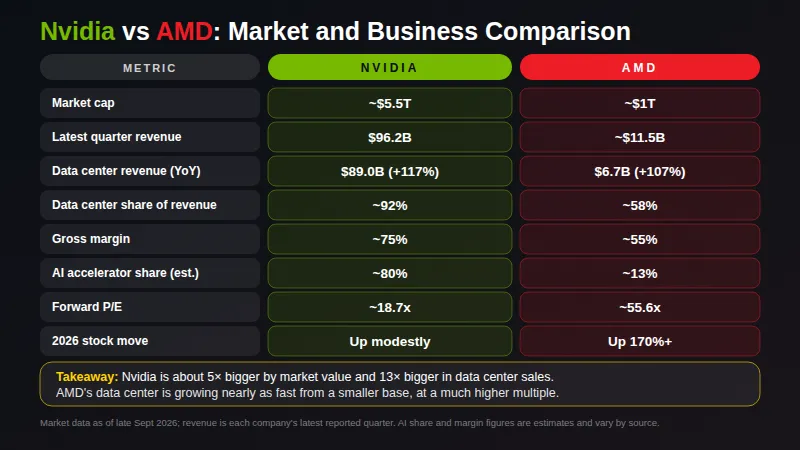
The businesses are at different stages and have different revenue mixes.
Nvidia’s Q2 fiscal 2027 revenue was $96.2 billion, up 106% year over year. Data Center contributed $89.0 billion, or roughly 92% of total quarterly revenue.
AMD’s Q2 2026 revenue was $11.5 billion, up 50% year over year. Its Data Center segment generated $6.7 billion, while Client and Gaming generated $3.8 billion and Embedded generated $977 million.
AMD’s business is therefore more diversified across CPUs, gaming, embedded products, and data-center products, while Nvidia’s current financial profile is particularly concentrated around data-center computing.
That difference is important when comparing the companies as businesses rather than simply comparing two graphics cards.
Nvidia vs AMD: share or stock comparison
Nvidia trades on Nasdaq under NVDA, while AMD trades under AMD.
As per the current reference point, the latest completed U.S. trading session before September 30, 2026 was September 29. It closed at approx. $227.21; it has a market capitalization of about $5.48 trillion.
The much higher AMD share price does not mean AMD is the larger company. Share prices cannot be compared directly because companies have different numbers of shares outstanding.
Market capitalization is more useful for comparing overall equity-market size.
Nvidia and AMD also have very different recent financial profiles. Nvidia’s latest quarterly revenue was $96.2 billion, compared with AMD’s $11.5 billion, although their reporting periods and business structures are not identical.
Stock prices change continuously, so these figures should be treated as dated market snapshots rather than fixed values.
Nvidia vs AMD: Advantages and Limitations
Nvidia advantages
Nvidia has built a broad software and hardware ecosystem around CUDA, AI computing, networking, and accelerated workloads. Its current RTX platform also offers features such as DLSS and dedicated ray-tracing and Tensor hardware.
The company also provides complete data-center platforms rather than selling GPUs in isolation, including networking and other infrastructure components.
Nvidia limitations
The higher-end RTX 50 lineup can require a substantial budget, with the RTX 5090 launching at $1,999 and the RTX 5080 at $999 in the U.S.
Its strong CUDA ecosystem is valuable, but that also means software compatibility should be checked carefully when building an AI or professional workstation around Nvidia hardware.
AMD advantages
AMD has a wide product portfolio covering CPUs, GPUs, AI accelerators, servers, embedded systems, FPGAs, and adaptive computing.
Its current Radeon lineup also provides 16GB configurations in products such as the RX 9070 XT, while the company continues expanding ROCm and its AI accelerator portfolio.
AMD limitations
AMD’s hardware and software support varies depending on the application. Anyone buying an AMD GPU for AI or professional work should check whether the programs, frameworks, plugins, and drivers they depend on support the particular Radeon or Instinct product.
That software check is especially important for specialist workloads.
Nvidia vs AMD: Which Is Better for Different Users?
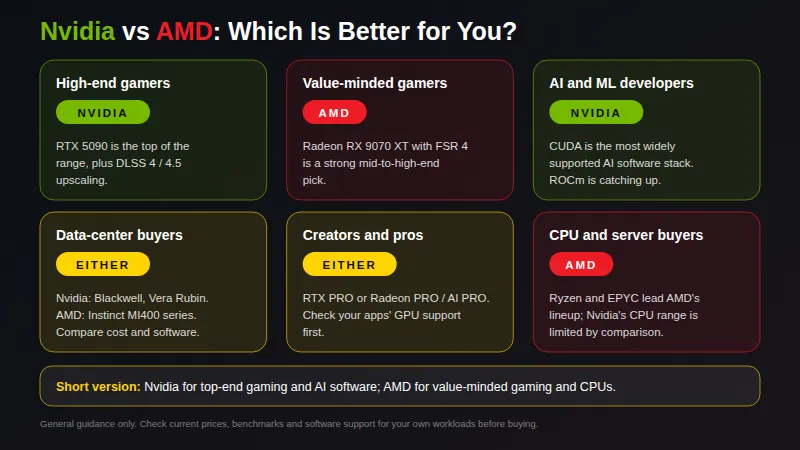
There is no single choice that fits every buyer.
For a gamer who prioritises ray tracing and Nvidia’s DLSS feature set, a GeForce RTX card may make more sense because Nvidia builds those capabilities directly into its current RTX platform.
For a gamer comparing Radeon and GeForce at a particular price, AMD may be worth considering where its memory configuration, game performance, and feature set fit the budget. The RX 9070 XT, for example, launched with 16GB of GDDR6 at a $599 U.S. starting price.
For AI developers working with CUDA-based software, Nvidia can provide a more direct path because CUDA is a mature GPU-computing ecosystem with dedicated development tools and libraries.
For teams using ROCm-compatible applications or looking for AMD’s open software stack, AMD offers a different route through ROCm and Instinct accelerators.
For professional workstation users, the decision depends on the applications being used, certification requirements, drivers, memory needs, and workflow compatibility rather than the brand.
For someone building a complete AMD-based PC, AMD can also offer the practical advantage of having Ryzen CPUs and Radeon GPUs under the same broader platform.
Nvidia vs AMD: Future Outlook
The competition between Nvidia and AMD is increasingly about full computing platforms rather than individual graphics cards.
Nvidia is moving from Blackwell into its Vera Rubin generation. The company said in its August 2026 results that Vera Rubin had entered production shipments in the third quarter of fiscal 2027, with systems being deployed through multiple partners.
AMD is also expanding quickly in AI infrastructure. Its 2026 roadmap includes Instinct MI400-series accelerators and the Helios rack-scale platform, while Data Center revenue has become a major part of the company’s overall business.
AMD has taken steps to strengthen its AI ecosystem outside traditional chip design. It announced on September 28, 2026, that it will buy World Labs in an all-stock deal worth around $8.2 billion.
Meanwhile, Nvidia continues investing heavily in AI infrastructure, networking, software, and new generations of accelerated computing.
For consumers, the takeaway is that the Nvidia vs. AMD comparison is becoming broader every year. The choice is no longer limited to which manufacturer produces the fastest graphics card. It can also involve AI software, drivers, memory, CPUs, networking, professional apps, and the ecosystem created around the hardware.
Ultimately, the most useful comparison is the one that starts with your workload. A gamer, AI developer, professional designer, and data-center operator can have completely different requirements, even when they are comparing the same two companies.
FAQs
Is AMD better than Nvidia for gaming?
Which is better for AI, Nvidia or AMD?
What is AMD ROCm?
Is Nvidia or AMD better for professional work?
Which is cheaper, Nvidia or AMD?
Does AMD have AI GPUs?
Recommended Stories for You

Team SR Jan 7, 2026

Nguyen Minh Dec 23, 2025

Yan li Dec 23, 2025
Startuprise Mar 20, 2025

Yan li May 12, 2025

Yan li May 6, 2025
Trending Stories

Medtech Startup Innovodigm Raises INR 5.5 Crore in Seed Funding Round

Incuspaze Acquires VSKOUT to Boost Tech-Enabled Real Estate Solutions for GCCs

Battery Smart Raises $29M in Ongoing Series B Funding Round

Fabheads Secures $10 Million in Series A Funding Led by Accel

Netgear Acquires Bengaluru Cybersecurity Startup Exium

Kimirica raises $15 million Funding Round

StrideGreen Secures $3.5M Seed Funding to Drive Climate-Tech Growth

Delhivery Acquires Controlling Stake in Ecom Express