

 Follow us
 Follow us
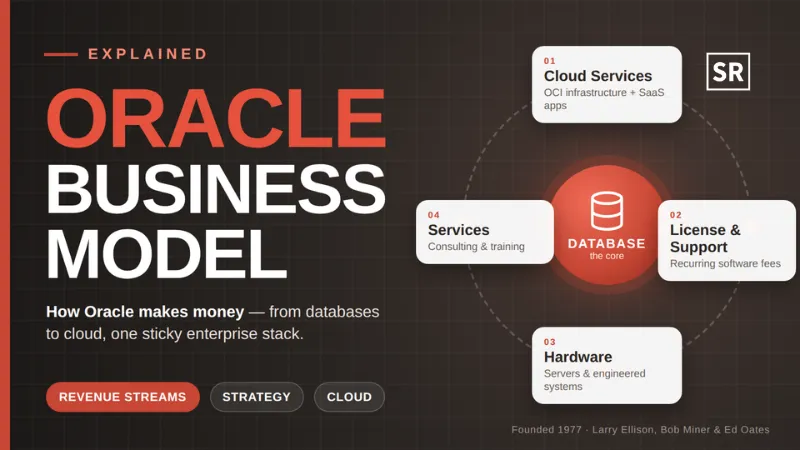
Oracle is one of the world's leading technology companies. It provides cloud services, database software, business applications, and other IT solutions to companies across different industries. Its products help businesses store data, run applications, manage finances, and handle their daily operations.
Oracle does not depend on just one product to make money. It earns revenue from cloud services, software subscriptions, database licences, business applications, hardware, and technical support. The company is also investing in cloud computing and artificial intelligence (AI) to create new growth opportunities.
Understanding Oracle's business model helps explain how the company serves businesses and earns money from its products and services.
1. What Is Oracle's Business Model?
Oracle follows a business-to-business (B2B) business model. This means it mainly sells technology products and services to other businesses, government organisations, and large institutions.
The company makes money through cloud subscriptions, software licences, technical support, hardware sales, and consulting services. This allows Oracle to earn money from both new customers and existing customers who continue using its products.
For example, a company might use Oracle Database to store information, Oracle Cloud Infrastructure (OCI) to run its applications, and Oracle Fusion Cloud Applications to manage its finances and employees.
Customers can choose individual products or combine several Oracle services to meet their business needs.
Oracle's business is mainly divided into cloud and software, hardware, and services. Cloud and software make up its largest business area, while hardware and services provide additional sources of income.
2. How Does Oracle Make Money?
Oracle earns money from several sources. Each source helps the company meet different customer needs.
A. Cloud Computing Services
Cloud computing is an important part of Oracle's business model. Through Oracle Cloud Infrastructure, the company provides computing power, data storage, networking, and database services over the internet.
Businesses can use these services without having to buy and maintain all their own computing equipment. Depending on the service, customers pay based on usage, capacity, or subscription agreements.
Oracle also offers cloud-based business applications that companies can access online. Customers pay to use these applications, giving Oracle an opportunity to earn regular revenue through ongoing subscriptions.
As businesses need more computing power or storage, they can increase their use of Oracle's cloud services. This creates opportunities for Oracle to grow its revenue while helping customers manage their technology needs.
B. Database Software and Licensing
Oracle became well known for its database technology. Oracle Database helps businesses store, organise, access, and manage large amounts of information.
Banks, retailers, healthcare companies, manufacturers, and other organisations use databases to manage important business data.
Oracle makes money by selling software licences that allow customers to use its products. Businesses can run the software on their own systems or use it in supported cloud environments, depending on their licensing agreements.
Some customers also pay for software updates and technical support. This allows Oracle to continue earning revenue after the initial software sale.
C. Enterprise Software and Business Applications
Oracle also provides software that helps companies manage their everyday business activities.
Its business applications cover several areas:
- Finance: Helps businesses manage accounts, budgets, and financial reports.
- Human resources: Helps companies manage employee information and workforce activities.
- Supply chain: Supports inventory, manufacturing, and delivery operations.
- Customer management: Helps businesses handle sales, marketing, and customer service.
- Enterprise resource planning (ERP): Connects different business activities through a shared software system.
These applications help companies manage important operations in one place and reduce the need for separate tools.
Many Oracle applications are available through cloud subscriptions. This allows the company to earn revenue for as long as customers continue using its services and renewing their contracts.
Oracle can also offer additional products to existing customers as their businesses grow.
3. Oracle's Other Revenue Sources
D. Software Maintenance and Technical Support
Businesses often need help keeping their software running properly. They may require technical assistance, software updates, security improvements, or help fixing problems.
Oracle offers support agreements that provide access to different types of technical assistance and product updates, depending on the agreement.
Customers who continue using Oracle's software may renew their support contracts over time. This gives Oracle another source of ongoing revenue.
Technical support also helps the company maintain relationships with customers and encourages them to continue using its products.
E. Hardware Sales
Oracle is known mainly for its software and cloud services, but it also sells hardware.
Its products include servers, storage systems, and specialised systems designed to work with enterprise software and demanding workloads.
Some businesses prefer to buy compatible hardware and software from the same provider because it can make installation and management easier.
Although hardware is a smaller part of Oracle's business than cloud and software, it remains an option for organisations that need specialised technology systems.
F. Consulting and Professional Services
Oracle also makes money by helping businesses set up and use its technology.
Its professional services can include software implementation, system migration, technical guidance, training, and other consulting work.
For example, a company moving its financial systems to Oracle Cloud may need help transferring its data, connecting existing applications, and training employees.
Oracle can provide support for these projects, helping customers use its products more effectively while generating revenue from professional services.
4. Oracle's Business Model at a Glance
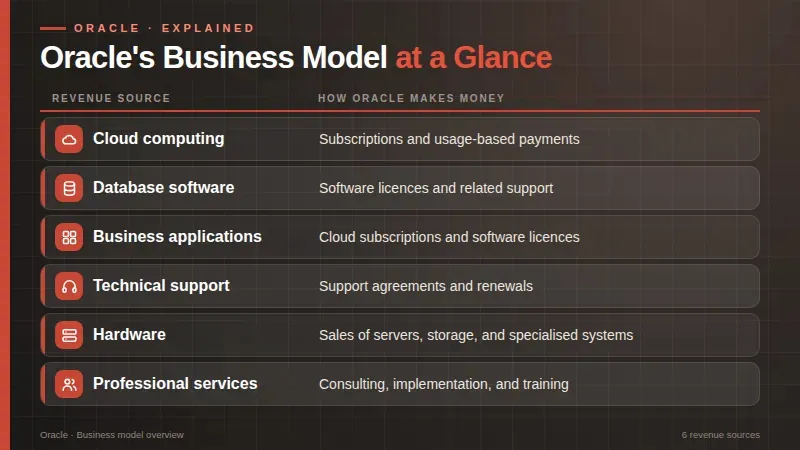
| Revenue source | How Oracle makes money |
| Cloud computing | Subscriptions and usage-based payments |
| Database software | Software licences and related support |
| Business applications | Cloud subscriptions and software licences |
| Technical support | Support agreements and renewals |
| Hardware | Sales of servers, storage, and specialised systems |
| Professional services | Consulting, implementation, and training |
By earning money from different sources, Oracle can serve businesses with different technology requirements and budgets.
5. Who Are Oracle's Main Customers?
Oracle mainly serves organisations that need reliable software and technology to manage their operations.
Its main customer groups include:
- Large companies: Businesses that need databases, cloud services, and enterprise applications.
- Banks and financial institutions: Organisations that manage large amounts of financial data.
- Government organisations: Public-sector bodies that need technology to run their operations.
- Healthcare companies: Organisations that use software to manage administrative and business activities.
- Retailers and manufacturers: Companies that manage stock, supply chains, finances, and customer information.
- Small and medium-sized businesses: Companies that need cloud applications and technology services without building every system themselves.
Oracle's wide range of products allows it to serve customers across different industries. It can also sell additional services to businesses that already use its technology.
Read Also- World’s Largest Sovereign Wealth Funds in 2026
6. What Makes Oracle's Business Model Strong?
Oracle competes with major technology companies such as Microsoft, Amazon Web Services, Google Cloud, and SAP. However, several factors support its business model.
Strong database technology: Oracle has years of experience in database software. Businesses that already depend on its systems may prefer to continue using them rather than move to a different platform.
Regular revenue: Cloud subscriptions and support agreements can bring in revenue over time, provided customers continue using the services and renew their contracts.
Wide range of products: Oracle offers databases, cloud infrastructure, and business applications. Customers can use several products together to manage different business activities.
Long-term customer relationships: Large businesses often rely on technology for their daily operations. Once Oracle products become part of these systems, customers may continue using them for many years.
Investment in cloud and AI: Oracle is expanding its cloud infrastructure and AI-related services. As businesses need more computing power to develop and run AI applications, Oracle has an opportunity to attract more customers. However, expanding cloud services also requires significant spending on data centres, equipment, and infrastructure.
7. What Challenges Does Oracle Face?
Oracle has a strong position in enterprise technology, but it also faces several challenges.
First, competition in cloud computing is intense. Microsoft Azure, Amazon Web Services, and Google Cloud compete for the same business customers.
Second, building and operating data centres is expensive. Oracle needs to invest in computing equipment, electricity, networking, and other infrastructure to support growing demand.
Third, moving business systems to a new platform can be costly and complicated. Some customers may delay these projects because of budget limits, technical problems, or concerns about business disruption.
Oracle must also keep improving its products to meet changing customer needs in AI, cybersecurity, databases, and business software.
These challenges can affect the company's costs, growth, and ability to attract new customers.
8. What Is the Future of Oracle's Business Model?
RECOMMENDED FOR YOU



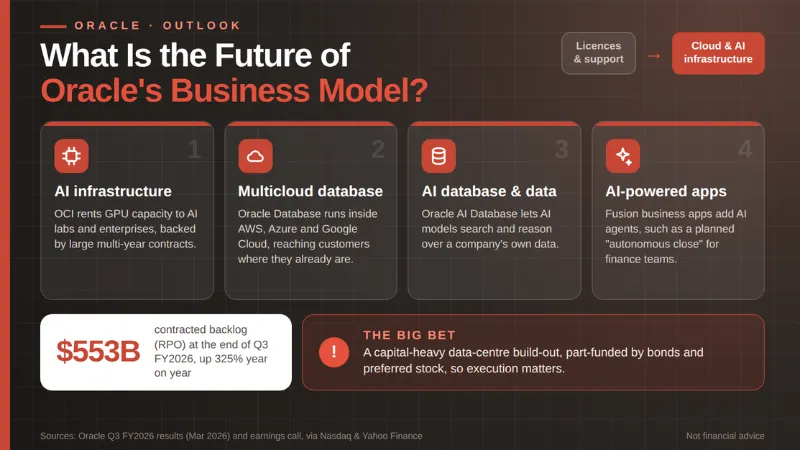
Oracle's future growth is closely linked to cloud computing, business applications, and AI infrastructure.
As more companies adopt AI, they need computing power, data storage, and reliable systems to run their applications. Oracle can support these needs through its cloud infrastructure, database technology, and business software.
The company also has opportunities to help existing customers move from traditional on-site systems to cloud services. These changes can create new subscription revenue and increase customer use of Oracle's products.
However, future growth will depend on customer demand, competition, infrastructure costs, and how effectively Oracle manages its investments.
Its established software business provides a strong foundation, while cloud computing and AI offer additional opportunities.
Conclusion
Oracle's business model is built around cloud computing, database software, enterprise applications, technical support, hardware, and professional services.
The company earns money through a mix of recurring subscriptions, software licences, support agreements, hardware sales, and consulting. This combination helps Oracle serve businesses across different industries and build long-term customer relationships.
As demand for cloud computing and AI continues to grow, Oracle has opportunities to expand its business. Its future success will depend on how well it competes with other technology companies, controls its costs, and meets customer needs.
FAQs
What is Oracle's business model?
How does Oracle make most of its money?
Is Oracle a SaaS company?
Who are Oracle's main customers?
How does Oracle benefit from AI?
Recommended Stories for You

Yan li Jan 2, 2026

Team SR Dec 29, 2025

Yan li May 12, 2025
Carmela Catilo Sep 29, 2026

Team SR Dec 26, 2025

Nguyen Minh Sep 15, 2026
Trending Stories

Top 10 Strongest Currency in Asia 2025

Best Startup Industries In 2026

What is a vision statement of a Company
China lifts ban on Boeing deliveries after Trump’s tariff deal

Ather Energy Shares Surge 2% on Strong Market Debut in India

Potato Corner Franchise in 2025 – Cost, Profit, Requirements, Review

Hua Hong and SMIC Shares Drop Sharply Amid Rising U.S.-China Tensions

Leading Asian Healthtech startups in 2026