

AI in Manufacturing: Use Cases, Benefits and Business Impact
Oct 5, 2026 | By Nguyen Minh
 Follow us
 Follow us
Artificial intelligence is changing manufacturing in ways that are becoming harder to ignore.
Factories have always relied on machines, data, and skilled workers, but AI is bringing these pieces together in a much smarter way. Instead of simply following fixed instructions, modern AI systems can analyze information, spot patterns, predict problems, and help people make better decisions.
For manufacturers, that can mean fewer machine breakdowns, better product quality, less waste, and faster production.
But there is an important point to remember: AI in manufacturing is not only about replacing people. In many situations, it is about giving employees better tools to do their jobs. A worker who gets an early warning that a machine may fail, for example, can deal with the problem before it turns into a costly production stoppage.
This is part of the wider move toward Industry 4.0, where machines, people, data, and infrastructure are connected. The conversation is already moving toward Industry 5.0 as well, which puts more emphasis on people, sustainability, and resilience.
What Is AI in Manufacturing?
AI in manufacturing means using artificial intelligence to improve different parts of the manufacturing process.
This can include technologies such as machine learning, computer vision, predictive analytics, and generative AI. These tools can help businesses understand what is happening on the factory floor and respond more quickly when something changes.
For example, an AI system can examine production data and notice that a particular machine is behaving differently from normal. Another system might inspect hundreds of products and identify defects much faster than a person could.
AI can also help manufacturers predict customer demand, plan production, manage inventory, and decide when equipment needs maintenance.
The important thing is that AI does not have to work separately from employees. It can work alongside them.
A factory worker might use an AI assistant to troubleshoot equipment, while a quality-control team uses computer vision to find defects. In another part of the business, managers might use AI-generated forecasts to decide how much inventory to order.
That makes AI less about one particular machine and more about improving the way the entire business operates.
Why Does AI Matter in Manufacturing?
Manufacturing is full of small decisions.
How much should be produced? When should a machine be serviced? Which supplier should be used? Is demand likely to increase next month? Why did the defect rate suddenly rise?
Traditionally, many of these decisions depended on historical reports, spreadsheets, manual inspections, and the experience of employees.
AI gives manufacturers another option.
It can process large amounts of information quickly and identify patterns that might otherwise be missed. When AI is connected to equipment, sensors, ERP systems, and other business tools, manufacturers can get a much clearer picture of what is happening across their operations.
That can lead to practical improvements in productivity, quality, production speed, and cost management.
Benefits of AI in Manufacturing
The benefits of AI depend on how it is used. A company does not automatically become more efficient just because it installs an AI system.
The real benefits appear when AI is connected to a genuine business problem.
1. Less Equipment Downtime
Unexpected equipment failure can be extremely expensive.
A machine may sit idle while technicians diagnose the problem, replacement parts are ordered, and repairs are completed. Meanwhile, production is delayed.
Predictive maintenance gives manufacturers a different approach. AI can examine information such as temperature, vibration, and other equipment signals to identify warning signs before a failure happens.
This gives maintenance teams an opportunity to act earlier instead of constantly reacting to breakdowns.
2. Better Product Quality
Nobody wants to discover a manufacturing problem after a product has already reached the customer.
AI-driven quality control systems are able to swiftly detect flaws in products as they are being manufactured. When manufacturers need to regularly inspect a large number of products, computer vision can be helpful.
The result can be fewer defective products, less rework, and lower scrap costs.
3. More Accurate Demand Forecasting
Producing too much can leave a company with excess inventory. Producing too little can lead to stockouts and missed sales.
AI can help manufacturers make better forecasts by looking at more than just previous sales.
Depending on the system, it can consider information such as current sales, weather, market conditions, search trends, social sentiment, and other demand signals.
That makes it easier to adjust production and inventory as customer demand changes.
4. Smarter Production Planning
Production schedules can change quickly.
A machine might suddenly become unavailable. A large customer order might arrive unexpectedly. A supplier could delay an important material.
AI-powered scheduling tools can take these changes into account and help manufacturers adjust their plans.
This can improve production flow, equipment utilization, labor productivity, and delivery performance.
5. Lower Energy Consumption
Energy is a major expense for many manufacturers.
AI can help businesses understand where energy is being used and identify areas where consumption could be reduced. Production schedules can also be adjusted to avoid unnecessary peak demand.
This can help lower operating costs while supporting broader sustainability goals.
6. More Support for Employees
One of the most interesting uses of AI is helping workers rather than simply automating their jobs.
Generative AI assistants, augmented reality, virtual reality, and other digital tools can give employees information when they need it.
For example, a new employee might use an AI-powered training system to learn a process, while an experienced worker might use an AI assistant to troubleshoot a complicated problem.
Cobots can also handle repetitive or physically demanding tasks, allowing employees to spend more time on work that requires human judgment.
7. Safer Workplaces
Some manufacturing environments can be dangerous.
Workers may deal with heavy machinery, extreme temperatures, repetitive physical tasks, or other hazards. AI can help reduce exposure to some of these risks.
Computer vision can monitor certain safety requirements, while AI-powered systems can analyze information and identify potential problems.
8. More Efficient Warehouses
The warehouse is another area where small improvements can make a noticeable difference.
AI can help determine when inventory needs to be replenished and support automated picking, packing, and movement of goods.
When warehouse systems are connected with sales and production information, businesses can make better decisions about what needs to be stored and when.
9. Faster Product Development
Creating a new product can take a lot of time.
Designers may have to create several versions, test them, find problems, and start again.
AI can speed up parts of this process by helping teams explore different designs and test ideas digitally before building physical prototypes.
That can make product development more flexible and reduce some of the time and cost involved in traditional trial and error.
10. Less Waste
Manufacturers are always looking for ways to use fewer raw materials, less energy, and less time while producing the same or better results.
AI can analyze information coming from machines and sensors and help identify inefficient processes.
When this information is combined with real-time demand and supply-chain data, manufacturers can make better decisions about how much to produce and when to produce it.
10 AI Use Cases in Manufacturing
AI can be used across almost the entire manufacturing lifecycle. Here are some of the most practical examples.
1. Predictive Maintenance
Predictive maintenance is one of the most established AI applications in manufacturing.
Machines can generate huge amounts of information through sensors. AI can analyze signals such as vibration, temperature, and other equipment data to look for signs of a potential failure.
Instead of waiting until something breaks, maintenance teams can receive an early warning and decide when intervention makes sense.
2. Quality Control and Defect Detection
AI-powered computer vision can examine products during manufacturing and look for defects.
This is particularly useful when products need to be inspected at high speed or when defects are too small or difficult for people to consistently identify.
Manufacturers can lower scrap and rework while maintaining more consistent product quality by identifying issues early.
3. Supply Chain Management
Supply chains can become complicated very quickly.
Manufacturers need to keep track of suppliers, inventory, transportation, demand, and potential disruptions.
AI can help by monitoring these different signals and identifying potential risks. It can also support procurement decisions and help businesses keep inventory closer to actual demand.
4. Demand Forecasting
AI can make demand forecasting more responsive.
Instead of looking only at what happened in previous years, AI systems can combine different types of information to identify changes in demand.
That information can then influence purchasing, production, inventory, and other business decisions.
5. Production Scheduling
Conventional production schedules might suffer.
AI-powered scheduling can consider equipment availability, demand, labor requirements, materials, and production constraints.
Instead of requiring managers to manually reconstruct the entire timetable in the event of an unforeseen circumstance, the system can assist in developing a more appropriate plan.
6. Energy Management
AI can help manufacturers monitor energy use and identify unusual consumption.
It can also help coordinate production and equipment schedules so businesses can reduce unnecessary energy costs.
For energy-intensive manufacturers, even relatively small improvements can have a meaningful financial impact.
7. Employee Training
Manufacturing companies constantly need to train workers, particularly when new equipment or processes are introduced.
AI-powered training tools can provide simulations, instructions, and real-time support.
Generative AI can also act as a kind of digital assistant, helping employees find information or troubleshoot certain tasks.
8. Safety Monitoring
AI can help manufacturers monitor safety conditions across the workplace.
For example, computer vision can be used to check whether workers are following certain protective-equipment requirements. Other AI systems can analyze safety information and help managers identify patterns that deserve attention.
9. Warehouse and Logistics Automation
Warehouses can become more responsive with the use of AI.
Demand signals can be used to refill inventory, and autonomous robots can help with product picking and transportation.
Connecting warehouse operations with production and sales data can make the entire process more coordinated.
10. Supplier and Procurement Optimization
Choosing a supplier is about more than finding the lowest price.
Manufacturers also need to consider reliability, financial health, performance, compliance, and potential supply risks.
AI can analyze these factors and help procurement teams make more informed decisions.
The Business Impact of AI in Manufacturing
RECOMMENDED FOR YOU


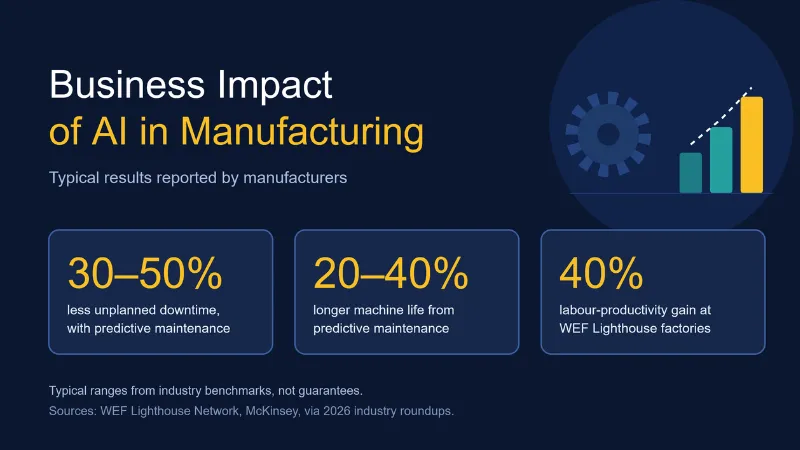
A manufacturer that reduces unexpected downtime can keep production moving. A corporation that discovers faults earlier can save money on scrap and rework. Reducing excess inventory is possible with improved demand projections. Employee and machine utilisation can be enhanced by more effective scheduling.
These individual advancements may eventually have an impact on the overall financial success of the business.
AI can potentially help manufacturers improve:
- Production output
- Equipment utilization
- Product quality
- Inventory management
- Delivery times
- Energy efficiency
- Employee productivity
- Operating costs
- Customer satisfaction
It can also open the door to more personalized products and flexible production.
Challenges of AI in Manufacturing
AI has plenty of potential, but manufacturers should not expect everything to work perfectly from day one.
There are several practical challenges to deal with.
Data Quality
AI needs good data.
If the information coming from machines, sensors, or business systems is incomplete or inaccurate, the AI system may produce unreliable results.
Manufacturers need to make sure their data sources are properly maintained and that important equipment is collecting accurate information.
Data Silos
Many manufacturers still have information spread across separate systems.
Production data may sit in one system, inventory information in another, and supplier information somewhere else.
AI works much better when these sources can be connected and understood together.
Cost
AI implementation can require significant investment.
Companies may need new software, sensors, computing infrastructure, integration work, employee training, and outside expertise.
For smaller manufacturers, using established cloud platforms may be a more practical starting point than trying to develop an entire AI system internally.
Skills Gap
AI needs people who know how to use it.
Manufacturers may need employees with skills in data analysis, automation, robotics, AI systems, and digital operations.
Reskilling existing workers can therefore become just as important as buying the technology itself.
Complexity
AI rarely works alone.
It may need to connect with ERP systems, IoT devices, robotics, sensors, and other technologies already used by the manufacturer.
Bringing all these systems together can be complicated, particularly for businesses that still depend heavily on older technology.
How Can Manufacturers Start Using AI?
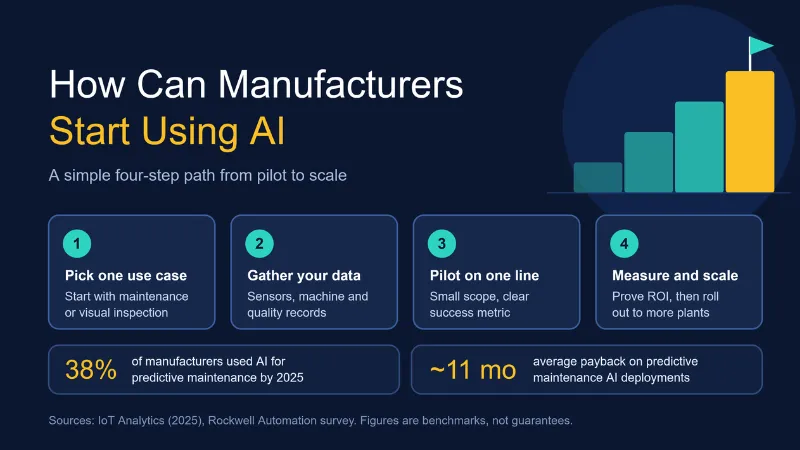
Manufacturers do not need to introduce AI everywhere at once.
In fact, starting small can be a much smarter approach.
First, identify a problem that is costing the business time or money.
Maybe machines are breaking down too often. Maybe quality inspections are taking too long. Perhaps inventory levels are consistently higher than they should be.
Once the problem is clear, the company can decide whether AI is actually the right solution.
From there, manufacturers can collect the necessary data, choose an appropriate technology, test the solution, and measure the results.
Employees should be involved throughout the process. They understand the day-to-day operation of the factory and can often spot practical problems that a technology team might overlook.
What Does the Future of AI in Manufacturing Look Like?
AI is likely to become a more normal part of manufacturing rather than something that sits in a separate technology department.
Factories will increasingly connect machines, sensors, software, workers, and business data. AI will then help interpret that information and recommend or automate certain actions.
Generative AI and agentic AI may also give workers new ways to interact with factory systems. Instead of searching through multiple reports, an employee could potentially ask a digital assistant a simple question and receive an answer based on current operational data.
At the same time, manufacturers will need to remain realistic.
AI is powerful, but it is not perfect. Companies still need good data, skilled employees, clear processes, and human judgment.
The manufacturers that benefit most may therefore be those that focus less on chasing every new AI trend and more on finding specific problems where AI can deliver measurable results.
Conclusion
Robots taking over factory floors is only one aspect of how AI is transforming industry.
AI can help manufacturers understand their equipment, predict demand, spot defects, manage inventory, improve production schedules, reduce waste, and give employees better information.
For a manufacturer, that can translate into something much more valuable than simply having advanced technology: a business that operates more efficiently and responds more quickly to change.
The key is to start with a real business problem, use reliable data, involve employees, and keep human oversight in the process.
When AI is used in the right places, it can become less of a buzzword and more of a practical tool for building a smarter, more efficient manufacturing operation.
FAQs
What is AI in manufacturing?
How does AI help with demand forecasting?
How does AI improve manufacturing safety?
What are the biggest challenges of using AI in manufacturing?
What is the role of generative AI in manufacturing?
How can a manufacturing company start using AI?
Is AI in manufacturing worth the investment?
Recommended Stories for You

Team SR Jul 1, 2024

Team SR Dec 29, 2025

Team SR Jul 20, 2024
Yan li May 12, 2025

Yan li Dec 16, 2024

Trending Stories

Top 10 Strongest Currency in Asia 2025
Best Startup Industries In 2026

What is a vision statement of a Company
China lifts ban on Boeing deliveries after Trump’s tariff deal

Potato Corner Franchise in 2025 – Cost, Profit, Requirements, Review

Ather Energy Shares Surge 2% on Strong Market Debut in India

Hua Hong and SMIC Shares Drop Sharply Amid Rising U.S.-China Tensions

Leading Asian Healthtech startups in 2026