


The Rise of the 24/7 Unmanned Economy and the “Operational Illusion”
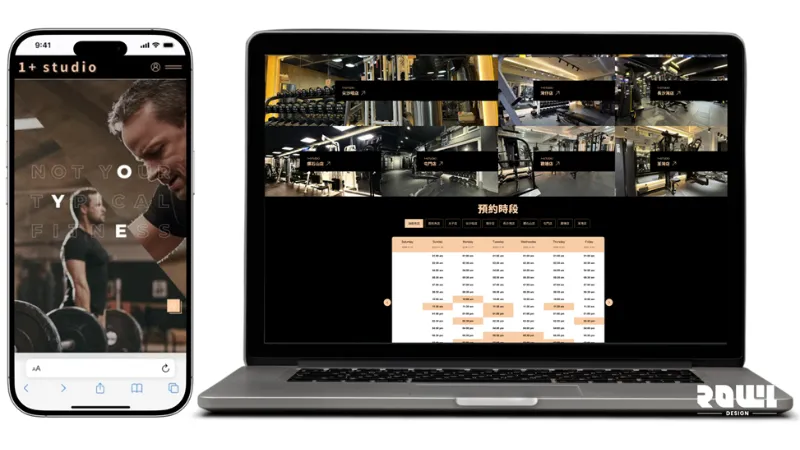
In Hong Kong’s highly competitive retail and service sectors, enhancing operational efficiency has become a core requirement for business survival. With high rental costs and structural labor shortages, 24-hour unmanned self-service models are rapidly spreading across industries such as fitness, self-service laundry, and shared workspaces. 1+Studio, a local fitness chain, has established a network of 10 branches across core districts including Wan Chai, Mong Kok, Kwun Tong, Tsim Sha Tsui, Prince Edward, Lai Chi Kok, Cheung Sha Wan, Diamond Hill, Tuen Mun, and Yau Ma Tei, aiming to provide customers with round-the-clock exercise spaces. However, for many businesses, this “unmanned” model is often an operational illusion before technical bottlenecks are resolved.
For many startups lacking deep technical integration, “unmanned” operations actually mean shifting front-line physical labor into back-end mental stress for managers. Before its system upgrade, 1+Studio faced a painful operational scenario: although their website allowed bookings, there was a technical disconnect between the system and the physical door locks. When a customer booked a session at 2:00 AM for a 6:00 AM slot, the owner or staff had to wake up in the middle of the night to verify payment and manually send the door code via SMS or WhatsApp. This “fake unmanned” state severely damaged the quality of life for managers and led to high error rates during peak booking periods, such as delayed messages or incorrect branch assignments.
The true technical challenge is that a professional web design company should offer value far beyond building an attractive booking page. In the case of 1+Studio, the core mission was to enable the website to “command” physical hardware in real-time. ROLLLL DESIGN shifted the project’s focus from interface display to building an “Intelligent Operating Brain” through deep hardware-software integration. This involves not only software logic but also the precise application of Internet of Things (IoT) protocols to eliminate manual intervention entirely.
Redefining System Boundaries: Replacing Manual Processes with Automation
To achieve true automation, the system boundary must be redefined. In legacy workflows, manual intervention is seen as a necessary checkpoint for verification; in a modernized architecture, these steps are handled by servers capable of logical judgment. 1+Studio’s transformation began with a thorough deconstruction of manual steps into automated digital commands.
Workflow Comparison: Manual vs. Automated
The following table details the differences in operational paths for 1+Studio before and after implementing the ROLLLL DESIGN system.
| Process Stage | Legacy Manual Mode (10 Branches) | ROLLLL DESIGN Automated Architecture |
| Customer Booking | Customer fills a form on the webpage | System verifies real-time slot availability |
| Payment Verification | Admin manually checks bank or payment records | Real-time payment signals received via Webhooks |
| Code Generation | Admin manually generates codes in the lock backend | System generates dynamic codes bound to the slot |
| Code Delivery | Admin manually sends messages via phone | Automated email push 30 minutes before booking |
| Entry Authorization | Manual operation or fixed codes (high risk) | MQTT protocol pushes real-time commands to locks |
| Financial Reconcile | Manual consolidation of monthly reports | Backend generates real-time financial and booking reports |
Analyzing the data shows that with 10 branches handling dozens or hundreds of bookings daily, the cost of manual communication and the risk of error grow exponentially. The system boundary defined by ROLLLL DESIGN is not just a website, but a closed-loop system integrating “Input (Booking & Payment),” “Processing (Logic, Blacklist Checks, Conflict Filtering),” and “Output (Lock Commands, Notifications, Financial Records)”.
Strategic Technical Selection: Why MQTT Over HTTP?
A critical part of the “Operating Brain” is ensuring the server can command locks across Hong Kong regions quickly and reliably. In early IoT development, many web design projects attempted to use traditional HTTP requests to control hardware, but the limitations of HTTP often lead to operational failure in unmanned environments.
ROLLLL DESIGN selected the MQTT (Message Queuing Telemetry Transport) protocol. This choice was based on a deep understanding of complex network conditions in IoT. Unlike the “request-response” model of HTTP, MQTT uses a “publish/subscribe” model, providing key advantages for 24/7 gyms:
1. Extremely Low Latency: Customers should not wait more than a few seconds at the door. The fixed header of MQTT is only 2 bytes, far lower than the hundreds of bytes in HTTP headers.4This ensures that the delay from “authorization” to the lock “opening” is less than 1 second, even in industrial buildings with poor internal network environments.
2. High Resilience to Network Fluctuations: Gym locks often operate on narrow-band or unstable Wi-Fi. MQTT features a “Last Will and Testament” mechanism and persistent connections, allowing the server to sense disconnects immediately and push pending commands as soon as the network recovers.
3. Optimization for Power and Bandwidth: For battery-backed hardware, MQTT’s lightweight nature is more power-efficient and performs several times better than HTTP when handling concurrent messages.
This technical selection represents a shift from simple web development to deep systems engineering. It proves that professional teams can now bridge the gap between software and hardware using low-level protocols to provide deeply customized solutions rather than template-based websites.
The Life Cycle of a Password: Dynamic Authorization and Security
In a 24/7 unmanned gym, security and convenience are often at odds. Fixed codes invite unauthorized access, while infrequent changes make it impossible to manage specific booking windows. The system built by ROLLLL DESIGN for 1+Studio utilizes “Dynamic Passwords with Strict Time Binding”.
The Dynamic Password Workflow
The system manages the “lifecycle” of every permission entering a branch, coupling identity verification with precise time dimensions.
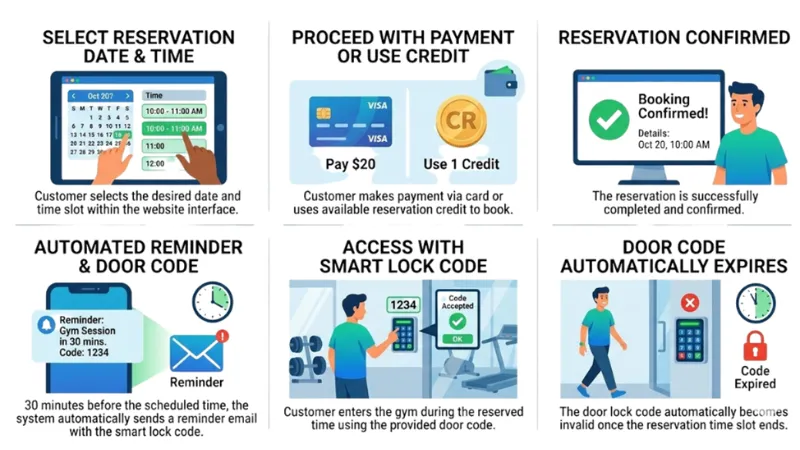
1. Payment Trigger: When a customer completes an online payment, the system receives a signal via Webhook. The backend marks the booking as “pending authorization,” recording the specific branch (e.g., Wan Chai or Kwun Tong) and the precise time window.
2. Time Window Trigger: An internal script activates 30 minutes before the booking starts. The system calculates the dynamic password’s validity based on Unix timestamps for the duration (e.g., 19:00 – 20:30).
3. MQTT Communication Details:
○ Topic Hierarchy: To support 10 branches, the system uses structured topics like gym/branch/wanchai/lock/set_code.
○ Payload: The JSON payload pushed to the lock includes the encrypted random code, start time, end time, and a unique booking ID.
4. Hardware-Side Validation: The lock subscribes to the topic and stores the authorization in local cache. This means even if the server fails during the booking, the lock can still grant access based on pre-stored data.
5. Expiration and Cleanup: Once the session ends, the lock automatically clears the code’s permissions without needing further commands, preventing overtime loitering.
This automation allows owners to sleep peacefully while the system accurately executes minute-by-minute tasks.3
Software-Defined Business Logic: Dual-Track Consumption Engines
Beyond hardware integration, business logic automation is key to 1+Studio’s scalability. Designing e-commerce solutions for the fitness industry requires balancing the needs of long-term members and walk-in guests.
ROLLLL DESIGN embedded a “Dual-Track Consumption Engine”:
● Credit Mode: Designed for long-term clients. Customers purchase credit packages (e.g., HKD 1000 for 1100 credits), and the system deducts them upon booking. This secures cash flow and increases customer stickiness.
● Single-Course Mode: Targeted at new or casual users, supporting Visa, Alipay HK, and FPS. Completion of payment results in an immediate booking.
Both models are unified in the backend for accounting, automatically generating reports and reducing manual reconciliation errors.
Eliminating the “Hidden Killer”: Passwordless Login and Self-Management
In app development or large web projects, customer service costs are often a “hidden killer.” For 1+Studio, a large portion of early inquiries involved “forgotten passwords,” “login issues,” or “checking balances”.
Secure and Convenient Email OTP
To lower the barrier to entry, ROLLLL DESIGN implemented a passwordless login mechanism (Email OTP). This brought multiple operational benefits:
1. Higher Conversion: Removing the burden of complex passwords improves the flow for users who just want to book quickly.
2. Ensured Communication: Mandatory email verification ensures that every member provides a valid address. This guarantees that notification emails containing door codes reach the customer’s inbox 100% of the time, preventing complaints about being “locked out”.
3. Reduced Support Costs: The backend no longer handles password reset requests, which also enhances security against credential stuffing attacks.
The Virtual Clerk: Customer Self-Management
A true unmanned gym empowers customers to manage themselves. The 1+Studio member dashboard allows users to check booking history, recharge credits, and even cancel bookings for refunds according to system rules. This effectively automates daily inquiries, with the system acting as a “7×24 Virtual Clerk.”
| Metric | Pre-System (Estimated) | Post-System (Measured) | Efficiency Gain |
| Processing Time per Booking | 5-10 mins (Manual) | 0 mins (Automated) | 100% Labor Saving |
| Midnight Inquiries | High (Missing codes) | Extremely Low | ~80% Reduction |
| Expansion Marginal Cost | Increases with branches | Hardware cost only | High Scalability |
| Financial Reconcile Time | 2-3 days per month | Instant Reports | Significant Cash Flow Efficiency |
Conclusion: How Technology Defines the Future of Operations
The 1+Studio case study is more than just a successful IoT project; it is a blueprint for Hong Kong SMEs facing high costs and labor shortages. It demonstrates that the goal is not just a website, but using “Software-Defined Hardware” to reshape business processes.
Enhancing Brand Reputation
According to Hong Kong Consumer Council data, complaints involving 24-hour gyms have increased recently, often regarding contract terms and privacy. By using a transparent online booking system and precise dynamic authorization, 1+Studio reduces human error and increases service stability. The system’s automated records provide solid data to resolve potential disputes.
Core Value for Owners: From “Trapped” to “Released”
The greatest return for 1+Studio’s founder is the change in lifestyle. Before the upgrade, the owner’s phone could never be silenced, and travel required carrying a laptop to handle booking requests. With the “Operating Brain” provided by ROLLLL DESIGN, management of 10 branches is fully handled by the protocol communication between the server and the locks. The owner’s role has shifted from “firefighter” to “strategist,” focusing on marketing and expansion.
If your business process still involves “manually sending notifications” or “manually verifying status,” that is your next point for automation. Whether it is retail, warehousing, or appointment-based services, businesses can achieve true 24/7 operations through MQTT hardware integration and customized architectures. This is not just a victory for technology, but a comprehensive evolution of business logic.
